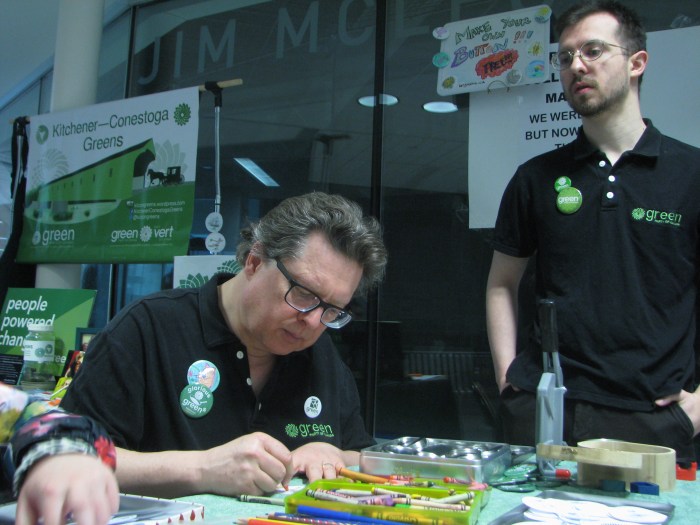
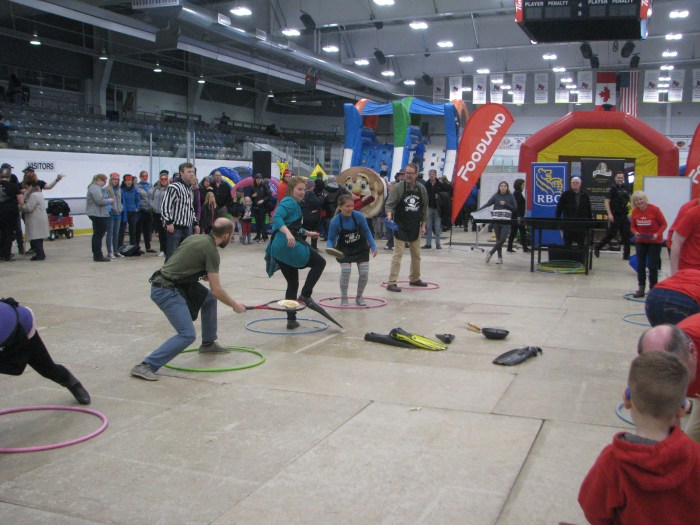
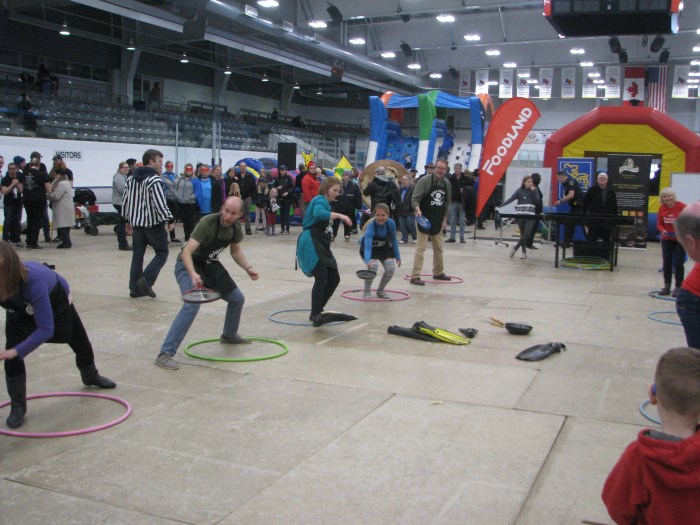
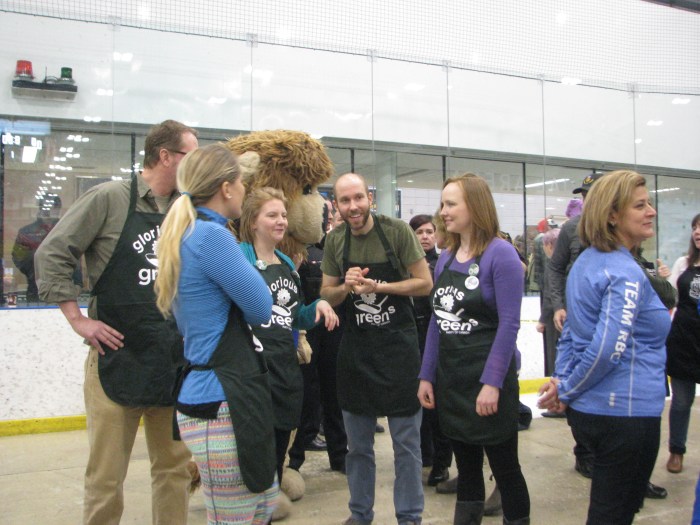
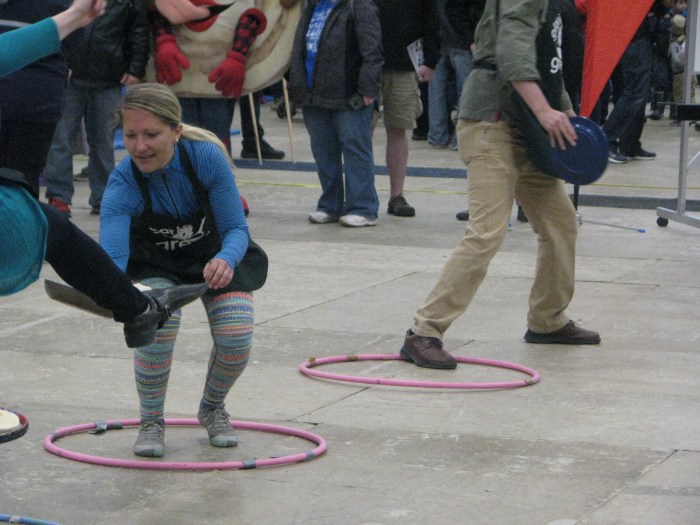
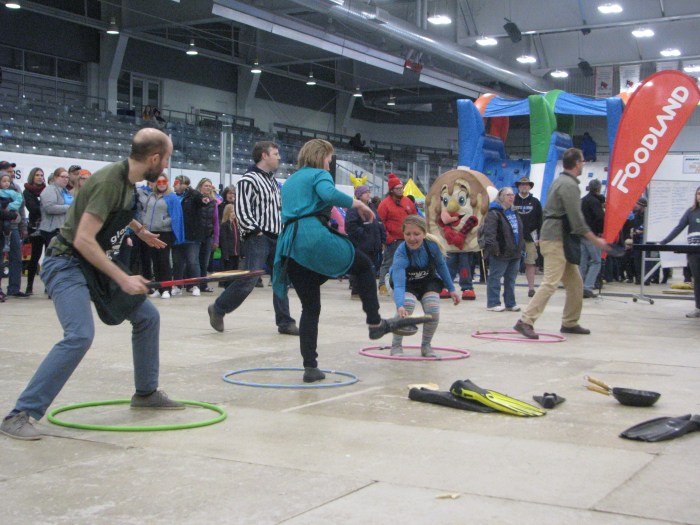
The Waterloo Region Greens attended the Elmira Maple Syrup Festival again this year, and a good time was had by all!





YouTube: Glorious Greens 2019
The Waterloo Region Greens attended the Elmira Maple Syrup Festival again this year, and a good time was had by all!
YouTube: Glorious Greens 2019
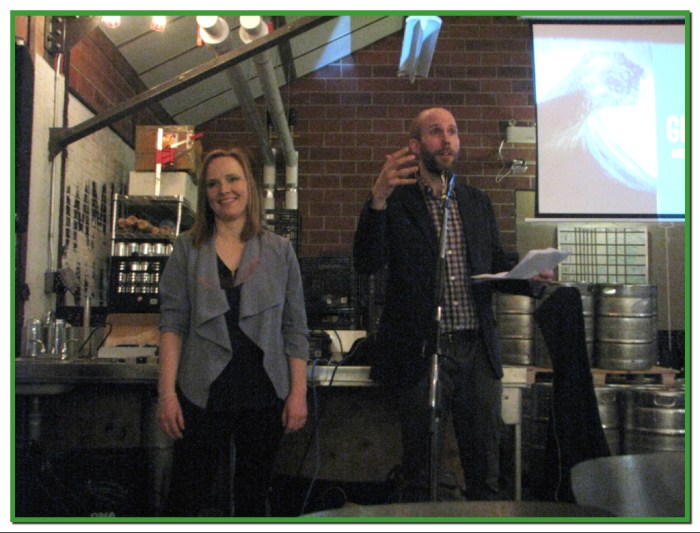
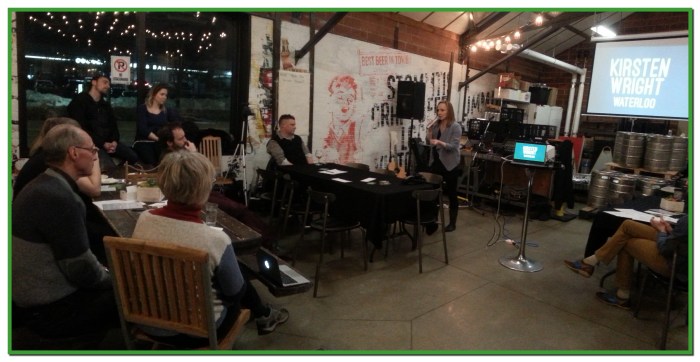 Kirsten Wright speaks to the crowd
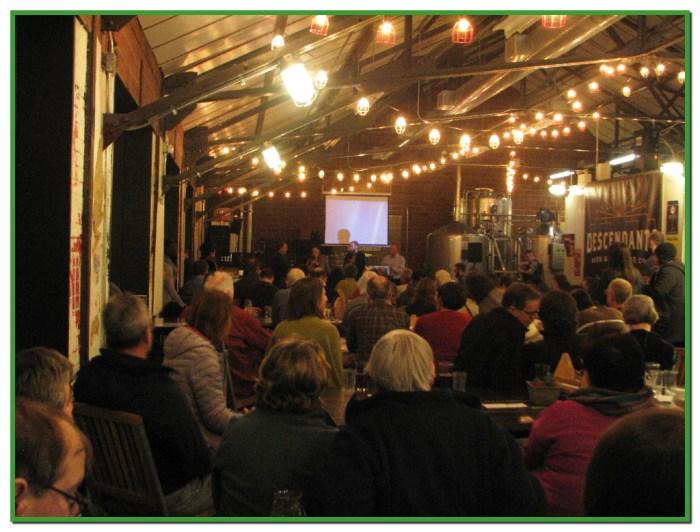
There was a packed house for the Kitchener Centre and Waterloo Green Party nomination contest, held at Descendants Brewery on Wednesday, 6 March 2019.

Green Party of Ontario Deputy Leader Abhijeet Manay
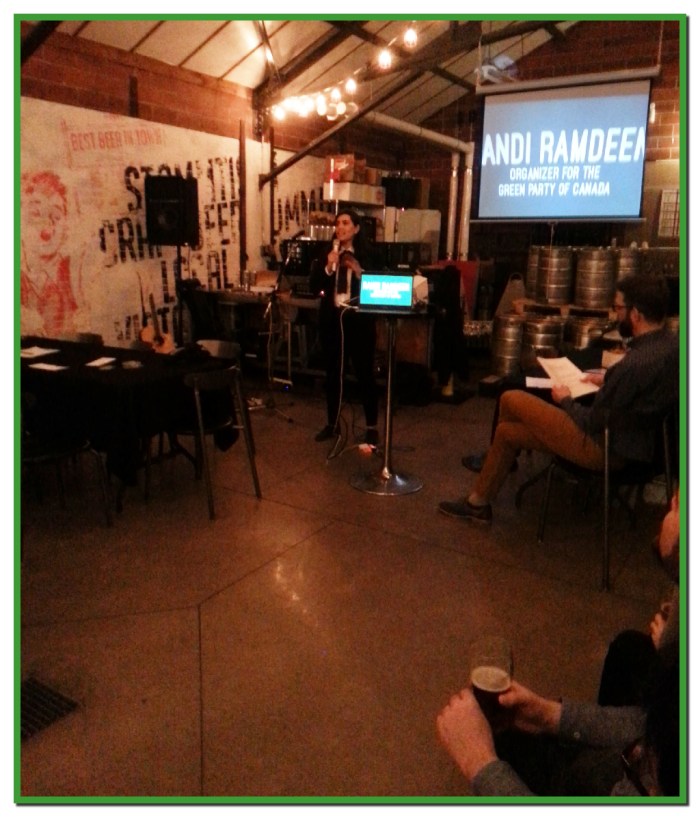
Green Party of Canada Organizer, Randi Ramdeen
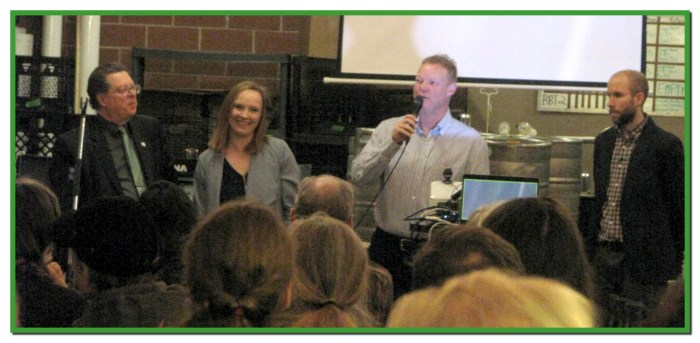
Bob Jonkman, Kirsten Wright, Ian Graham and Mike Morrice
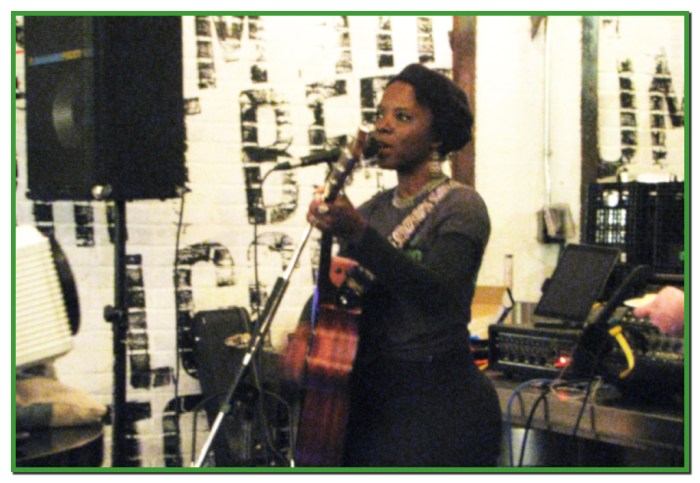
Music by Joni NehRita
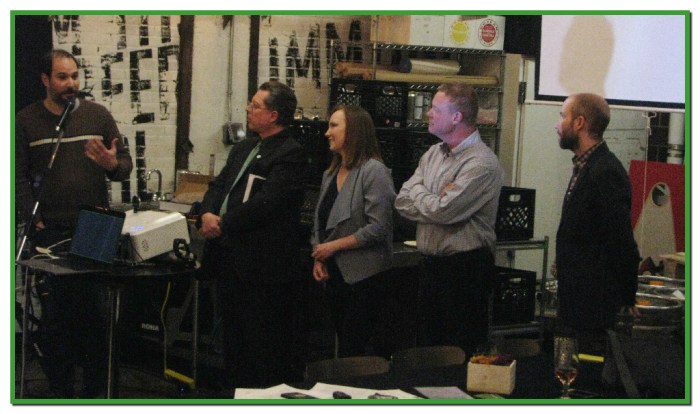
Candidate Nominee Q & A
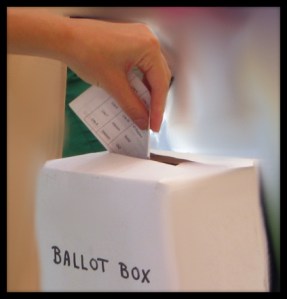
It was my job to prepare the ballot boxes and voting materials for tonight’s @wr_greens nomination meeting. Zero-emissions delivery coming right up! #cdnpoli pic.twitter.com/Ro6H3fB0gH
— Sam Nabi (@samnabi) March 6, 2019
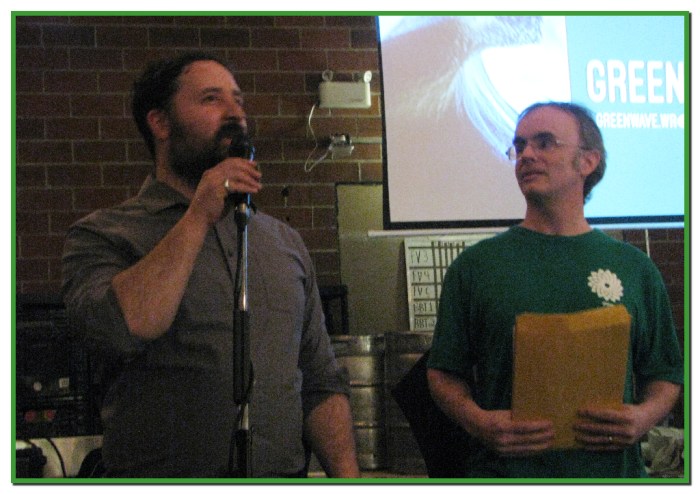
Returning Officers Matt Piggot and Dave Doulson
Congratulations to Mike Morrice for winning the Kitchener Centre nomination, and to Kirsten Wright for winning the Waterloo nomination!
And many thanks to all those from the Waterloo Region Greens who helped put on this event, the largest Green Party nomination contest in Waterloo Region history!
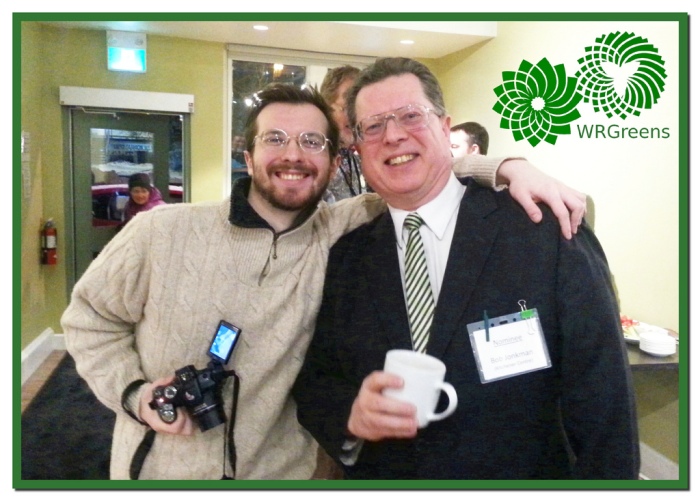
Bob Jonkman has championed Proportional Representation since he volunteered for Fair Vote Canada in the 2007 referendum. As an Executive Member of the very active Fair Vote Waterloo Region Chapter, Bob came to believe electoral reform could best be accomplished by entering politics. He ran for office federally in 2015 and provincially in 2018 as the Green Party candidate in Kitchener—Conestoga.
Working with local social justice organizations has helped foster Bob’s commitment to achieving the goals of equity and inclusion. His community service includes work with the WRNonviolence Day In The Park, KWPeace, and as an active member of the Social Development Council of Waterloo Region. Bob has volunteered with the PTA, worked to save Victoria Glen Park from development, fought the placement of a biogas mega plant in downtown Elmira, and served on the Elmira BioFuel Citizens’ Committee. In his spare time Bob enjoys participating at CKMS-FM, the local community radio station where he is on the Board of Directors.
Bob’s digital community service includes organizing and giving presentations at computer user group meetings. As a long time member of the Free Software community, Bob encourages the use of software that respects computer users’ freedom. He’s a strong advocate for transparent government and freely available Open Data in government and business, balanced with protection of personal privacy through cryptography and safe online practices.
Professionally, Bob is a small business owner providing computer consulting, technical support and training to large and small Ontario businesses.
Born in the Netherlands and raised in Burlington, Ontario, Bob and Laurel chose to move to Elmira to raise their son twenty years ago.
Bob’s commitment to the Green Party is rooted in shared values that have inspired his work to enact positive change for a stronger democracy and a sustainable future.
More about Bob:
Follow Bob:
email: bob.jonkman@greenparty.ca
The nomination contest will be held on Wednesday, 6 March 2019 from 7:00pm to 8:30pm
New location!
Descendants Beer & Beverage Co.
319 Victoria Street North, (Map)
Kitchener, Ontario
This is a free event, but please register at Eventbrite.
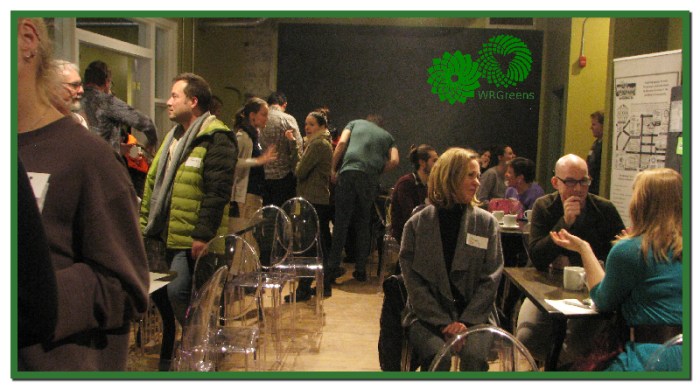
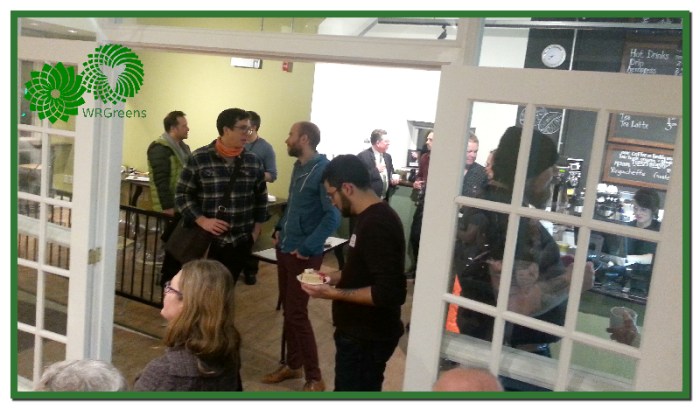
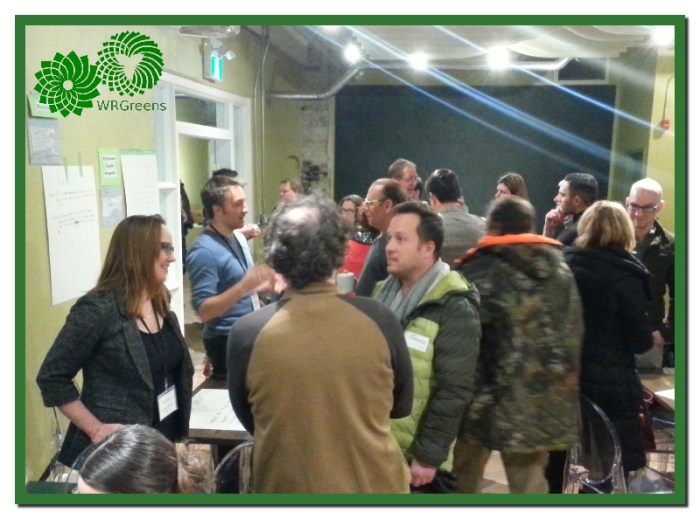
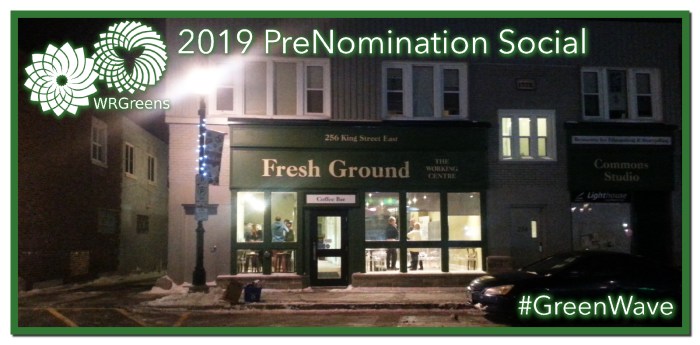 Last week’s WRGreens PreNomination Social was a fabulous success.
WRGreens will be holding 2 nomination meetings. The first will be a combined meeting for Kitchener Centre and Waterloo. Today—Monday February 4th, 2019— is the last day to join the Green Party and be eligible to vote to choose which of these nominees will be the 2019 Green Party Candidate!
This is the lineup of 2019 GPC nominees for Kitchener Centre:

And here are the GPC candidate nominees for Waterloo.

Over the next month, each of the nominees will be asked to tell you a little bit about themselves here. We’ll also be publishing videos for each on the WRGreens YouTube page.
The Candidate Nomination will take place on Wednesday, March 6, 2019 at 7:00pm – 8:30pm.
You must live in the riding and attend the nomination meeting in person to vote.
You can register on the Eventbrite page here:
https://www.eventbrite.ca/e/green-party-nominations-for-waterloo-and-kitchener-centre-tickets-54805128615
or on Facebook here:
https://www.facebook.com/events/497935980731834/
Don’t forget: today is the last day to join the Green Party of Canada to choose the 2019 Kitchener Centre and Waterloo candidates!
Since becoming personally involved in elections, I’ve found myself watching televised election coverage on Election Night. This year, that was at Ethel’s Lounge in Waterloo with three of our 5 Waterloo Region Greens Candidates and WRGreens volunteers and supporters.
Each broadcaster concentrates on the ridings their partisan experts consider important, instead of showing the riding results equally, so it’s hit or miss for all the rest. We chose to watch TVO’s coverage that night at Ethel’s, as TVO was the only MSM broadcaster to include a Green leaning commentator.
At the end of the day, it’s hard to get the big picture. So for my own interest, I decided to check out Elections Ontario (unofficial results) to get an idea how our Green Candidates did overall. Although I did this for my own interest, Bob pointed out this might be of interest to others, so here it is.


 (note: the above all candidates image is actually in three pieces, part 1 is the first 6 rows, part 2 the next 5 rows, and part 3 the last 5 rows. Click on the section you want to see the segment at full size.)
All five of our Waterloo Region Greens candidates did very well overall.
Kitchener South—Hespeler candidate David Weber‘s 7.53 riding vote percentage was the 6th highest in Ontario (up from 7th in 2014). Kitchener Centre‘s candidate Stacey Danckert ranked 9th with 6.84%, Kitchener—Conestoga candidate Bob Jonkman ranked 11th with 6.51%, Cambridge candidate Michele Braniff ranked 14th with 6.27%, and first time candidate Zdravko Gunjevic ranked 24th with 4.83% in Waterloo.

And while I know from personal experience how lucky Waterloo Region has been to have such an excellent roster of WRGreens candidates, I have met enough other Green Party Candidates to know this isn’t really unusual. Frankly, I am continually stunned by the calibre of Green Party Candidates in general. Although the Green Party has far and away the best policy of any of the top four parties, putting your hat in the ring requires a great deal of time, money and effort for any candidate. It’s a big personal investment no matter which party a candidate is running for, and Greens are faced with additional handicaps:
Green Candidates are well aware of how little chance they have of being elected, but in spite of everything, excellent Green Party Candidates keep stepping up.
Stacey Danckert brought us all together under the unofficial WRGreens umbrella during the 2015 federal election, and our regional cooperation is paying off. Cooperating, sharing our experience and resources has been incredibly helpful for us here in Waterloo Region.
And not just during elections. We’ve been actively working to raise the Green profile between elections, by hosting information tables at local summer festivals where we can, hosting our own events and participating in others as appropriate, and building our online presence on the WRGreens blog. We’re always learning, and we’ll do it even better next time. Especially now that Mike Schreiner has won that so important first seat.
I know how hard it can be to stay positive, and to keep focus on the campaign. But after media suppression, I think our worst threat is falling prey to propaganda.
The strategic voting narrative continues to be powerful, and it is always the worst when it strikes from within.
In many ways I think this is especially difficult for Greens, because Greens are the unparty party, the party that applauds other parties when they appropriate our ideas, even when implemented badly, because it’s a start.
The stakes are so high that sometimes a candidate falls victim to strategic voting propaganda, and suggests their supporters vote instead for a competitor who might win against a greater evil. This really isn’t surprising in a party that understands the importance of working together for the common good. Green Candidates aren’t professional politicians, they’re people from all walks of life who get involved because they understand our future is at stake and change is no longer optional. They’re in this because serious issues that need to be addressed, not for the greater glory of the party.
One of the reasons strategic voting is wrong is that it is always built on the faulty premise that old statistics— whether gleaned from past elections or recent opinion polls— can accurately predict who might win. If this were true, there would be no need for the trouble and expense of elections.
In this campaign, I was particularly unhappy to see a terrible strategic voting meme initiated by Meanwhile In Canada. The post in question actually told voters to vote NDP except in 5 cases, where it said voters should vote Green because Green candidates could win in those 5 ridings. Some Green folk helped spread this meme thinking it might help change the perception that Green candidates couldn’t win.
I don’t know what exactly that prediction was based on, but two of the candidates who went on to rank in the top 5 percentages in their ridings were excluded from the 5 supposedly winnable ridings. We will never know how many more votes those candidates (or all the Green candidates MiC strategically dismissed) might have won if that social media maven hadn’t been telling voters to vote against Greens in the last week of the campaign.
Although there are no scientific studies of which I am aware, I think Strategic Voting is the most powerful vote suppression tool going. When people are convinced their vote won’t have any effect, or worse, that it will help elect the boogeyman provided by our FPTP system, many feel the only responsible choice is not voting.
We only get one vote. That’s not a vote for a party. It’s not a vote for a party leader. It’s a vote for our local representative. I have to wonder how much better Greens would do in elections if they didn’t have to spend half the election explaining what’s wrong with Strategic Voting.

Green Party of Ontario Leader, and Guelph MPP candidate Mike Schreiner‘s 45.04% riding vote percentage was the highest in Ontario. This resulted in the first seat in the Legislative Assembly of Ontario won by an Ontario Green Party Candidate. Parry Sound—Muskoka‘s candidate Matt Richter ranks 2nd with 20.02%. Laura Campbell ‘s 12.53% of the vote won in Dufferin—Caledon placed her in 3rd position; Barrie—Springwater—Oro—Medonte candidate Keenan Aylwin’s 11.72% of the vote ranks him 4th, and Dave Rodgers 8.64% in Wellington—Halton Hills makes him the 5th highest ranking Ontario Green candidate by percentage.
The Green Party of Ontario is making history, and these five candidates are leading the way forward. Onward!
[Republished from the KitCon Blog’s “Statistics”]
The event was a series of round tables connecting people with candidates, interspersed with 3-5 minute talks by candidates and representatives from the local culture scene. The speaking order was determined by drawing names out of a bowl, and as it happened, our Green Candidates dominated the beginning of the evening.
Waterloo Candidate Zdravko Gunjevic started the evening off with a look at the importance of Public Libraries in our shared culture (if you listen closely you’ll hear an Ontario Cabinet Minister heckle him)
Next up, Kitchener-Conestoga Candidate Bob Jonkman considers the impact of culture on our most vulnerable citizens
And finally, Kitchener Centre Candidate Stacey Danckert spoke about the importance of public support for the creators who make our culture
WRGreens were honoured to be included in this valuable event.
Tonight, Ontario MPP Candidates from all parties across the Region have been invited to speak at The Museum: A Cultural Exchange 6.0
Join the Waterloo Region Greens tonight at The Museum. Here’s a clip of Kitchener—Conestoga candidate Bob Jonkman speaking at the 2015 Museum event.
This discussion is centred around the issues facing people with developmental disabilities and their families in Waterloo Region. It will provide an opportunity for members and organizations involved in the developmental services sector to hear learn about the policies offered by local politicians and their parties over the next four years.
Care has been taken to ensure this is not a debate. The panel of participants represent the four major parties in the 5 Waterloo Region constituencies with no candidate running against each other in the upcoming election.
CATHERINE FIFE, MPP Candidate 
Ontario New Democratic Party ~ Waterloo
KATHRYN MCGARRY, MPP Candidate 
Ontario Liberal Party ~ Cambridge
DAIENE VERNILE, MPP Candidate
Ontario Liberal Party ~ Kitchener Centre
BOB JONKMAN, Candidate 
Green Party of Ontario ~ Kitchener—Conestoga
AMY FEE, Candidate 
Progressive Conservative Party of Ontario ~ Kitchener South—Hespeler
The audience will be individuals with an interest in the Developmental Sector, primarily family, self-advocates and persons supported by the Sector and people volunteering or working in the Sector or related Sectors. The purpose of the evening is for candidates to outline their Parties Platform related to the Developmental Sector and to speak to the issues related to the Sector.
This event is being jointly hosted by:
If possible, the organizers would appreciate an RSVP indicating the number of people who will attend:
by email info@wrfn.info, or
by phone 519-886-9150;ext=1
Thu, 26 April 2018, 6:30pm – 9:00pm
Holiday Inn Kitchener Waterloo
30 Fairway Rd S, Kitchener
ON N2A 2N2, Canada (map)
Come out to support Bob Jonkman, Kitchener–Conestoga’s 2018 GPO candidate in this pre-election Panel Discussion.


On Tuesday October 6th, 2017 #KitCon Greens Laurel and Bob joined the Guelph Greens to celebrate the Grand Opening of their new Office.


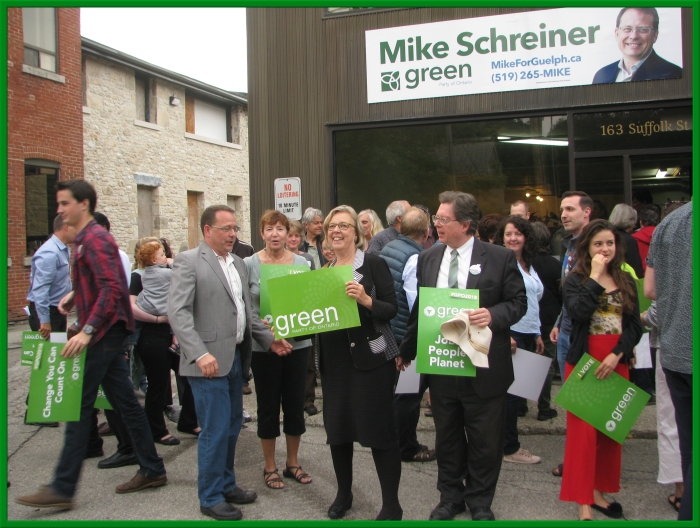
[Reblogged from Kitchener Conestoga Greens]
Photo Credit
All photos © by Laurel Russwurm and released under a
Creative Commons Attribution License.
Find more photos from the Opening in the KitConGreens Flickr Album
 Computer security people will be able to tell you:
You can have a secret ballot OR a secure system, but not both. Internet banking and commerce can be secure, but only because the bank knows who the customer is.
Fair Vote Waterloo says:
On Referenda, Consultations, and Postcards
Australian Computer Expert Vanessa Teague:
Election explainer: why can’t Australians vote online
Daily Dot takes a much more technical look:
Online voting is a cybersecurity nightmare
“The” computer security expert, Bruce Schneier agrees:
More Voting Machine News
Barbara Simons asks: Why can’t we vote online?
Online voting is one of the things Canada’s ERRE Special Committee on Electoral Reform has been tasked with studying, so WRGreens own Bob Jonkman framed this important issue in the Canadian context in his Submission to the ERRE Consultation:
“I am opposed to electronic voting and online voting. I am a computer consultant by profession, and nothing I see in my work shows that people’s home computers or even the computers in most businesses have the security capable of upholding the Integrity requirement, ensuring reliable and verifiable results.
“The main issue with online voting is not computer security, but a fundamental incompatibility between voter identity and the secret ballot.
“When voting takes place outside of a polling station it is important that voter identity is established to prevent fraud. It must be provable that the ballot filled in online was actually filled in by a registered voter, and not by someone impersonating that voter. To achieve this, voters need to be issued a ballot with a serial number or barcode to ensure that only that one ballot is filled in for that registered voter. But if every ballot cast has a serial number, then the completed ballot with the voter’s choices is identifiable with the voter’s name and registration information. The secret ballot is impossible, and the Integrity criterion cannot be met.
“When voting does not take place in a polling station then it is possible that a voter will be coerced into voting according to the demands of the “head” of the household, or voting at the workplace according to the employer’s demands. Without the scrutiny of Elections Canada, voting integrity cannot be ensured.
“But computer security is an issue too. People’s personal computers are constantly being attacked by computer viruses, malicious web sites, and denial of service attacks from compromised Webcams. And spam. The difficulty of ensuring online voting integrity is at least as great as is the difficulty of eliminating spam (unsolicited, unwanted e‑mail, sometimes commercial in nature, sent in bulk). If you haven’t experienced problems with spam then it is likely your E‑mail Service Provider is filtering your e‑mail for you – but how many good messages are being filtered accidentally? You’ll never know, because you’ll never see them.
“There are actually very few large-scale spammers on the Internet, maybe a couple of dozen at most. But they’re responsible for almost all the unwanted e‑mail that clogs up billions of e‑mail accounts in the world. It shows how a few bad actors on the Internet can completely overwhelm an e‑mail system. Similarly, a few bad actors on the Internet can completely compromise an online voting system. If we can’t secure our mail systems to solve the spam problem, it is unlikely that we’ll be able to secure everyone’s computer to guarantee online voting integrity.
“It is unfortunate that there were so few computer security experts providing witness testimony to the Committee. Almost every computer security expert who has commented on electronic voting since the U.S. “hanging chad” elections in 2000 has decried the use of voting machines, and, more recently, online voting. Voting machines are regularly compromised, are not auditable by design (they have proprietary source code), and are prone to failure when needed most. Computer security lecturers delight their audiences with tales of voting machine touch screens that dodge the target when the “wrong” vote is selected, or that play marching band music after they’ve been compromised by a prankish hacker.
“Voting is very much different from buying a product from an online store. If the wrong product is delivered, the store will ship the right product the next day to ensure customer satisfaction. But if the wrong candidate is elected, there is no recourse the next day. It is unlikely that fraud will be detected until the voting machines are audited many weeks after the election, and even when fraud is detected the outcome will be hotly contested by the affected candidates. In fact, if voting machines don’t use publicly published open source code then it is likely election outcomes will be hotly contested because proving that no fraud was committed is impossible.
“However, vote tabulation by machine is perfectly acceptable, although there must be a requirement that vote tabulators are also audited and their source code is made public. Ballots designed for vote tabulators (optical mark cards) can always be counted manually if the electronic tabulation is in dispute.”— Bob Jonkman: Electoral Reform — My Submission to the #ERRE Committee
Here’s hoping the #ERRE Committee puts Online Voting aside until it might be accomplished securely.

 wrgreens