Off and Running in Kitchener Centre

The Green Party in Kitchener-Centre is getting ready for a provincial by-election later this year.

Nearly 100 people showed up on Tuesday May 2 for the nomination event in the pavilion. Members from Kitchener Centre were complemented by small groups from Waterloo, Guelph (including MPP Mike Schreiner), and elsewhere. 

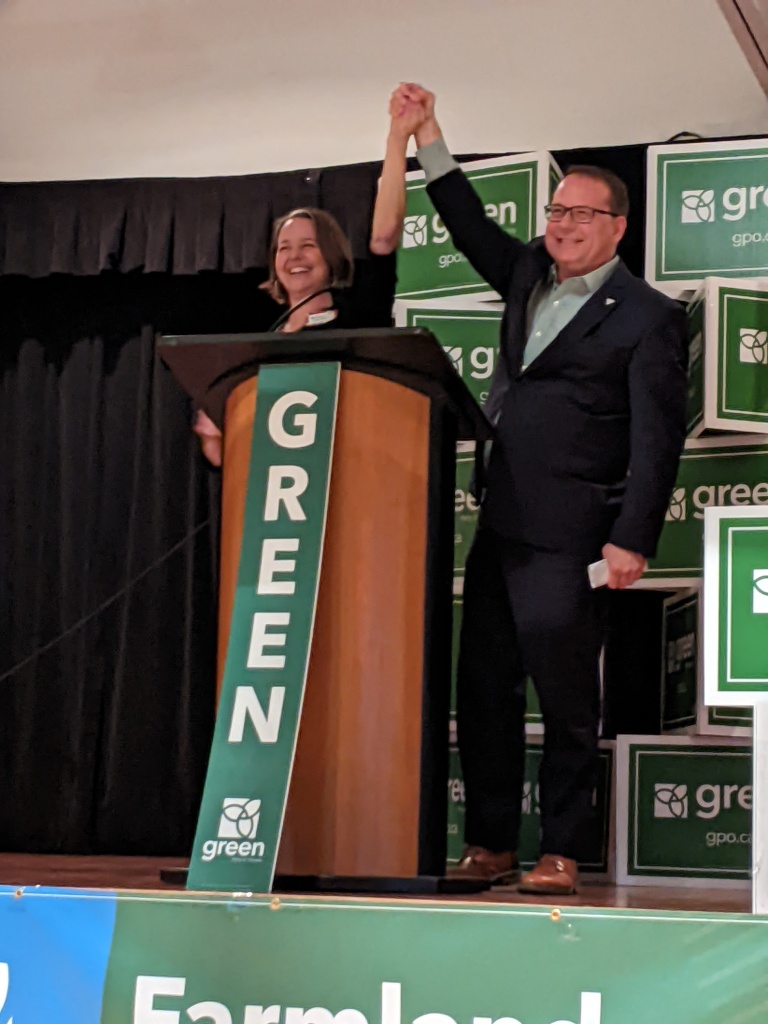
All four candidates had a chance to give a speech while the votes were being tallied online. At the end of the hour, the winner was announced: current city councilor, Aislinn Clancy.

Mike Schreiner raises Aislinn Clancy's hand high amongst Green Party of Ontario signs.

“It takes a lot of juice to win,” she said. Then she implored us to charge our batteries and get ready for a fight. “The climate can’t wait”, and “we can’t leave it to the people that broke it to fix it”… “We have no choice but to act”. Like many of us, the tide turned for her when she saw the scale of the environmental problems our current policies are promoting.

She continued, explaining that Green candidates help us to live our values by allowing us to vote for an outsized voice in parliament. Green political activism is the antidote to our existential angst caused by climate change and urban sprawl, she explained. Helping people to live their values is important. We should all be living our values everyday. 

Aislinn is also strongly rooted in Kitchener. She called out the financial pain that renters are feeling and how some kids are being failed by the education system.

After she spoke, donations to her campaign poured in both from the dozens of Zoom attendees, and clipboards were passed around the pavilion to record pledges. Winning elections takes money, and Aislinn is already on a roll for the bi-election around the corner.

Take action to support Greens in Kitchener: support Aislinn’s campaign: or sign up to volunteer on Aislinn’s campaign. See you out there!

Thoughts About Water

You may have recently seen the CBC article about communities in Arizona losing their water supply. But that’s not likely to happen here, is it? Yes, water supply has been an issue in our region. For example, the demand for water in West Montrose outstripped its supply, requiring water to be shipped in by truck, and the installation of  a new pipeline. And, water from aquifers in Elmira continues to be unsafe to drink due to industrial dumping of NDMA and chlorobenzene from agent orange and DDT production. Although it was identified to be leaking into the watershed 30 years ago, it still has not been completely cleaned up. Currently, there is no technology that can completely clean up this  mess.

I recently attended a talk by Bob Burtt, retired reporter who has written 3 books about the chemicals in Elmira’s water and other issues of water in Waterloo Region. His current book raises alarms about the Ford government rolling back generations of protections on water sources, safety, and flood protections. “Water – Our Sacred Trust” is a great resource for local history and issues surrounding water.

There were times in the past when our water supply was severely stressed. The recent stability has been due to diligent regional planning and management. As our population grows, it’s unclear where we will get enough water. Will we have to build a pipeline from Lake Erie, which has pollution issues of its own?

When I asked Bob why politicians finally started to take action regarding Elmira water, he indicated there had been intense resistance to even acknowledging the problem; he believes it was only due to the efforts of a group of dedicated and persistent individuals that some action was finally taken.

As individuals, we can take steps to conserve water and contribute to addressing this issue. Simple actions like sweeping patios and driveways instead of hosing them off, avoiding using tap water for watering lawns, and collecting rainwater in barrels for gardening and tree care can all make a difference. Additionally, being politically active and advocating for strong water protection measures is an individual action that can help safeguard our precious water resources for future generations.

While the recent article about communities in Arizona losing their water supply may seem distant, water supply challenges are also present in our region. By staying informed, taking action to conserve water, and advocating for robust water protection policies, we can play our part in ensuring that our water resources remain safe and sustainable for years to come.

Green Candidate Nomination for the Provincial By-Election

There will be a by-election in Kitchener-Centre later this year due to MPP Laura Mae Lindo stepping down.

Green candidate selection is well under way with 4 strong community leaders putting their names forward! 

If you reside in the Kitchener-Centre riding and are a member of the Green Party of Ontario, you are eligible to vote for who you would like to see as your Green candidate. We need your vote to ensure we have the strongest candidate! A ranked ballot vote will take place online from April 30 to May 2 – if you are a member in good standing you will receive an email with voting instructions.

On April 12, the candidates were introduced in a virtual meeting, which you can view on YouTube.

The nomination meeting is on May 2, where we will count votes and announce the winner. Everyone from across the region is invited to attend the meeting either virtually or in-person.

It’s important we know who is coming, so please let us know if you will be attending in person by registering here, or virtually by registering here.

If you have any questions about the meeting or voting process, please email Teresa Cornwell at nominations@gpo.ca.

Coldest Night of the Year

On February 25th, 5 local Greens gathered to support Ray of Hope as part of the Coldest Night of the Year fundraising event.

We walked through downtown streets that are home to the unsheltered in our community. Together we raised $395, and with 77 teams and 725 walkers from across the region we raised more than $220,000!

Thanks to Mike, Mats, Allen, Simon, and Jenna for being part of this.

The event will next be held on February 24, 2024… Let’s do it again!

Climate Consultation: Deadline Midnight

Laurel L. Russwurm's avatarLaurel's Free Culture Blog

The Government of Canada is holding another Climate Consultation. Despite the fact they completely ignored the public input from the 2016 in-person Climate Consultation, it is important for every Canadian concerned about the Climate Crisis to participate. This time, they don’t have a majority government, so they have to at least pretend to listen to us.

You don’t have to be a climate expert to partcipate… climate change is already affecting all of our lives. The policies our governments make will either help or make it worse. So far, Canadian policies have only made it worse.

The deadline for submissions is tonight at midnight, so to make it easier, I’ve reproduced the questions so you can think about what you will say before you go online. It’s important to note that the “tell us more” essay questions each have a 5,000 character limit.

Privacy
They’ve made this an anonymous survey…

View original post 1,569 more words

Call to Action by Persons Concerned about MS

I receive many emails from local voters who ask me about specific issues that are important to them. Often, there is a pattern because a non-profit or advocacy organization has provided a well-drafted format and many concerned citizens follow the format and send me an email. This is the first in a series of blogs. I try to send a reply to each person but, in case things get busy, I am blogging my response.

The Green Party of Canada has a bold and innovative plan to re-imagine the future of Canadians.  The Plan has ten main areas of focus.  I have copied four headings from the standardized email (in bold) and included my comments. 

The emails usually ask about reform to EI Sickness Benefits and to the Canada Disability Benefit.  There have been recommendations in Canada since the March Report in the 1940’s and the Macdonald Commission in the 1960’s to avoid Canadians falling through the gaps of our social safety net.  The solution is to ensure a livable income or Guaranteed Livable Income, as it is now called.   

Make work…work

The Green Party of Canada supports moving to a Guaranteed Living Income.  Practical recommendations are at the GPC web-site at: https://www.greenparty.ca/en/reimagining-our-future/renegotiate-our-social-contract.  In addition, as part of the GPC’s focus on Re-Imagining a Safer, Fairer World, we have a strategy for a different kind of economic policy, specifically one which guarantees a good job for anyone who can work.  Rather than an economic system which always seeks unlimited growth, our goal is to maximize human (and environmental) health and well-being).  Check this out on the same web-page.

I was a self-employment advisor for Lutherwood in a program for entrepreneurship for persons with disability.  Through this experience, I am well aware of the disincentives to employment or self-employment by the current system which seems less about offering opportunities than preserving an unjust system built on stigma and barriers. 

Make ends meet

The Guaranteed Living Income would more equitably and efficiently allow for support for episodic disability.

Make access a reality

At the GPC web-site we Re-imagine Our Future. One of the ten areas reminds Canadians that “we are all in this together” with emphasis on taking care of each other.  An essential way to take care of each other is through a National Pharmacare system.  The Green Party sees enormous financial benefits in bulk buying through such a national system thereby lowering the over-all cost of health care while improving accessibility to important treatment.  Check this out at: https://www.greenparty.ca/en/reimagining-our-future/remember-we-are-all-in-this-together

The Green Party also advocates for National Standards and quality for long-term care with national guidelines for staffing and high quality of care and for more options for housing.  This is outlined at the remember-we-are-all-in-this-together link, noted above.

In addition, the Green Party has strategies for safe and affordable housing, with more funding for co-op, supportive and community-developed local housing.  This is part of our focus on Local and on Resilience. 

Check it out at: https://www.greenparty.ca/en/reimagining-our-future/resilience-is-local-and-made-in-canada

Make MS research a priority

One of the basic priorities for the Green Party is Evidence-Based Decision Making and the development of evidence-based policy making and increased socio-demographic data collection.  Greens advocate for government funded research to be available to all Canadians.  This is outlined at:  https://www.greenparty.ca/en/reimagining-our-future/require-evidence-based-decision-making

I believe an over-riding aspect of the emails like this one is the desire for consultation with respect to policy reform.  The Green Party is committed to grass roots democracy with our platform based on input from members and based on science, research and the lived experience of Canadians.  As an elected member of Parliament, I would consult with the community of self-advocates living with MS. 

I hope this blog helps voters who are concerned about MS. 
In Defence of Minority Government in a Democracy

Michele Braniff
Michele Braniff

I am running with the Green Party of Canada to initiate government policies to protect the planet and to create conditions for resilient people, families and communities. For me, it is all about environmental and social justice and democratic rights, responsibilities and values. As I have been campaigning and speaking to voters, many have questioned the safety of calling an election during a pandemic and expressed concern about how this fits with our Canadian democratic values.

The 43rd Parliament was the result of democracy at work: in 2019, Canadians voted so that no one party had a majority of the seats in Parliament. The Liberals won only 157 seats. The Samara Centre for Democracy explained in their December 2019 blog:

Minority governments often compel parties to work together, as the leading party must cooperate with Members of opposing parties in order to push forth their legislative agenda. Contrary to popular beliefs, some of the most productive governments in history have been minority governments. For example, the Canadian healthcare system was brought into place by a minority government.

Before and through the challenges of the COVID19 pandemic, the parties all worked together: there was compromise and collaboration. The 43rd Parliament was a functioning minority government with non-partisan support during a pandemic. Perhaps, history will regard this success as another example among “some of the most productive governments in history”. I would have liked to see: more leadership on the climate crisis; stronger reconciliation with Indigenous people; and a Green Recovery plan from the pandemic. Nevertheless, the government was functioning, as well as could be expected with Justin Trudeau as Prime Minister and a Liberal caucus.
Usually, a minority government ends because the governing party is not able to maintain the confidence of the House of Parliament. That is not what happened in August, 2021. The Liberals did not lose the confidence of Parliament on any policy, new laws or a budget. Parliament was functioning. Arguably, it was functioning extremely well in difficult conditions and because of shared concern for the safety of Canadians. In my view, it was functioning better as a minority government than the previous majority 2015 Liberal government.

In the midst of a pandemic, while the country is at risk of a fourth wave, Justin Trudeau decided to dissolve Parliament and call for an election. Canadians voted in 2019 so that no one party had a clear majority.

In the current “first-past-the-post system”, there are often “false majorities”, by which a minority of votes generates sufficient seats in the legislature for a majority government. In 2019, although the voting results were skewed, Canadians nevertheless did not agree to give any one party a majority of seats. If Canadians are not in agreement about leadership, the responsibility of the elected representatives is to work together, across party lines to develop consensus.

The Green Party advocates for electoral reform, including proportional representation; increased respect in Parliamentary debate; and greater non-partisan collaboration. A minority government requires non-partisan collaboration.

If politics in Canada were based on values, leaders would prioritize keeping Canadians safe during a pandemic. If politics were value-based, leaders would respect the decision of the 2019 election. If Canadians elect a minority government, there is a responsibility on the members of Parliament and especially the Prime Minister to work with the mandate from the electorate and resist the temptation to “shop” for a preferred mandate.
Vote for democracy: vote Braniff and the Green Party of Canada! Vote for a healthy planet, a resilient green economy and for social justice in Canada!

Waterloo Region Greens in Election 2021

Meet your Green Candidates in Waterloo Region

Cambridge

Michele Braniff

Kitchener-Centre

Mike Morrice

Waterloo

Karla Villagomez Fajardo

Kitchener-Conestoga

Owen Bradley

Kitchener South-Hespeler

Gabe Rose

TONIGHT: Why Canada needs Guaranteed Livable Basic Income

Ontario Liberal Party's Basic Income Consultation, Waterloo Region (January, 2017)
Back in 2017, Bob Jonkman participated in the Waterloo Region
Basic Income Consultation
hosted by the Ontario Liberals before their Pilot.

Thursday, September 17, 2020 – 19:00 to 20:30

The Green Party has long advocated for a Guaranteed Livable Income.  Tonight you’re invited to join Green Party MP Paul Manly as he hosts a virtual national town hall with Coalition Canada: Basic Income in discussion about the Guaranteed Livable Basic Income.  The panel of experts will explain the basics, consider the benefits, and bust some myths about basic income.

Panelists:

  • Senator Kim Pate: An independent senator who has advanced the national conversation around basic income. Senator Pate is a nationally renowned advocate who has spent nearly 40 years working in and around the legal and penal systems of Canada, with and on behalf of some of the most marginalized, victimized, criminalized and institutionalized — particularly imprisoned youth, men and women.
  • Tracy Smith Carrier: Associate Professor in the School of Social Work at King’s University College at Western University. Dr. Smith-Carrier’s research and policy analysis, examines if, and how, marginalized groups access programs and services in the post-welfare state. Her current research projects involve examining trends in intergenerational social assistance receipt, research on charitable and justice models of social support, human rights, and the design and delivery of basic income. She is Chair of Basic Income, London Ontario.
  • Evelyn Forget: Economist and Professor in the School of Medicine at the University of Manitoba. Dr. Forget’s research has focused on the data associated with a basic income field experiment conducted in Manitoba in the 1970s. She has been consulted by governments in Ontario, British Columbia, Quebec, Finland, the Netherlands and Scotland on this topic. Her research has been featured on CBC Ideas, PBS Marketplace, and in the documentary The Free Lunch Society. An updated edition of her book, Basic Income for Canadians, is due out Oct. 12th.
  • Robert Case: Associate Professor of Social Development Studies at Renison University College, Waterloo, and Chair of the Wellington Water Watchers, a Guelph-based water advocacy organization. Dr. Case’s research and teaching interests include social welfare policy; community organization; community resilience, localism and community-based activism; social development and the environment; social ecology.
  • Monika Ciolek: Monika was a participant in the Ontario Basic Income pilot project. She is a sole support parent and a self-represented performance artist based out of Hamilton, Ontario. Having spent 14 years on Ontario Works, and over 20 years learning her industry, Monika has dealt with issues of women’s rights within the cultural sector.

Live simultaneous French translation will be provided.

REGISTER NOW

https://zoom.us/webinar/register/WN_LhSFdmXqSdWRtkJMUk4rvA

source: https://www.greenparty.ca/en/content/why-canada-needs-guaranteed-livable-basic-income

Last Day to sign up to vote for the new #GPC Leader!

Eight GPC Leadership Candidates on the ballot:  David Merner, Annamie Paul, Andrew West, Meryam Haddad, Amita Kuttner, Glen Murray, Courtney Howard and Dimitri Lascaris

If you want a say in who the next Leader of the Green Party of Canada will be, it’s not too late!

To vote in the Leadership Contest, you must be a member of the GPC.

Today, September 3rd, 2020 is the LAST DAY in which you can join the Green Party of Canada (or renew your lapsed membership) to be a voting member.

There’s a diverse slate of eight awesome candidates:

Join the Green Party of Canada