What are fossil fuel subsidies, anyway?

When we talk about climate action in Canada, the conversation often turns to fossil fuel subsidies — the billions of dollars our Federal and Provinical governments, as well as Export Development Canada, have been spending to support our oil & gas sector. The 2015 Paris climate agreement, signed last fall by the current Federal government, gives new urgency to keep global temperature rise below two degrees. To do that, we need to keep fossil fuels in the ground.

A bird's-eye view of a Fort McMurray industrial plant, next to a dense boreal forest.
Fort McMurray. (Photo courtesy Flickr user sbamueller)

This week, the “Three Amigos” summit saw Canada, the U.S., and Mexico agree to common goals for transitioning to a low-carbon, clean energy future. Like the Paris agreement, it’s a generally positive committment that needs to be followed up — soon — with action.

The “North American Climate, Clean Energy, and Environment Partnership”, as it’s called, re-affirms Canada’s 2009 committment to phase out fossil fuel subsidies in the “medium term”. This week’s news sets a more specific goal — Canada, the U.S., and Mexico have agreed to a phase-out date of 2025.

So let’s get going. If Canada is serious about transitioning away from fossil fuels, we need to do much more than the Liberal election platform proposes (a modest scaling-down of one particular tax deduction). We still have a complex web of subsidies that benefit the oil & gas sector. They all need to go.

Deductible expenses

Tax deductions let corporations declare expenses to reduce their taxable income. These four programs directly encourage the expansion of fossil fuel operations at home and abroad:

  • 10% deduction for Canadian Oil and Gas Property Expenses (e.g. buying oil sands rights, buying a well, leases, permits, and licenses)
  • 30% deduction for Canadian Development Expenses (e.g. expanding a mine, building new haulage routes)
  • 30% deduction for Foreign Resource Expenses (e.g. overseas exploration and drilling of fossil fuels)
  • 100% deduction for Canadian Exploration Expenses (e.g. surveying land for new fossil fuel extraction opportunities, environmental studies, and community consultations before opening a mine)

Provincially, B.C. also offers a 20% tax break on coal mining expenses through the Mining Exploration Tax Credit.

Accelerated Capital Cost Allowance

Capital Cost Allowance (CCA) is a way for all kinds of businesses to deduct the cost of equipment over several years.

Accelerated Capital Cost Allowance (ACCA) speeds that process up, putting money back into the hands of fossil-fuel companies faster and reducing their taxes.

While the ACCA no longer applies for oil sands projects, it was recently introduced for liquified natural gas (LNG) projects.

24900325_62b5650908_o
Canadian mining truck. (Photo courtesy Flickr user Neil and Kathy Carey)

Duty exemptions

In 2014, Canada eliminated duty fees for offshore oil and gas drilling equipment. This makes it more affordable for Canadian companies to drill for fossil fuels in our vulnerable Atlantic and Arctic waters.

Flow-through share deductions

Normally, tax deductions can only be claimed by the business that actually incurs the eligible expense. However, flow-through shares let corporations pass on the deductions directly to investors, whose income gets taxed as capital gains, at half the rate of regular income.

Canada allows flow-through shares for qualifying Canadian Development Expenses and Canadian Exploration Expenses – a sweet kickback for both corporations and their individual investors.

 Royalty credits

In Canada, natural resources such as minerals, oil, gas, and groundwater are owned by the Provinces. They charge royalties to companies that extract these resources.

B.C. offers a Deep Drilling Credit that waives royalty fees between $444,000 and $2.81 million per well for new fossil-fuel drilling projects.

B.C. also offers up to 50% discount on royalites for oil & gas companies to build new roads and pipelines through the Infrastructure Royalty Credit Program. The purpose of the program is to boost oil & gas exploration, and extend the drilling season year-round.

Reduced sales tax

Both Manitoba and B.C. don’t charge provincial sales tax on machienry and equipment involved in oil, gas, and mining. This includes prototyping equipment, surveying and exploration equipment, and even drill bits. There’s also a discount on the electricity required to operate the machinery.

 Where do we go from here?

This week’s “Three Amigos” agreement needs to be followed up with aggressive action.

  • If we are to keep the planet from spilling over that 2-degree threshold, we can’t continue funding dirty fuels.
  • If we’re going to encourage clean energy development, we can’t keep incentivizing oil & gas exploration.

As we move forward, remember that there is a lot of work to be undone. It starts with dismantling these subsidies.


Further reading


Image Credits

Fort Mc Murray IMG_0679 © by sbamueller and released under a Creative Commons Attribution-ShareAlike 2.0 Generic (CC BY-SA 2.0) License

Wabush Mines Truck © by Neil and Kathy Carey and released under a Creative Commons Attribution-ShareAlike 2.0 Generic (CC BY-SA 2.0) License

49th K~W Multicultural Festival Weekend

join WRGreens @ K~W Multicultural Fest 2016
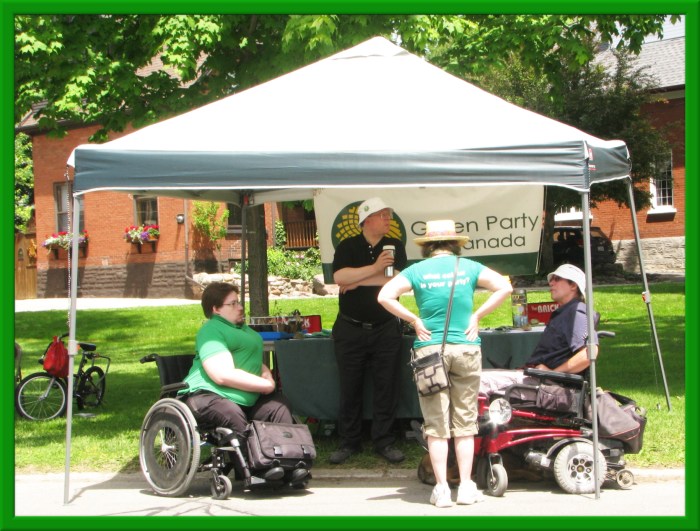
Visit the WRGreens info booth at the K~W Multicultural Festival  in Victoria Park
Saturday June 25th, 2016
Noon – 8pm
Sunday June 26th, 2016
Noon – 6pm

Sign Elizabeth May’s Electoral Reform Petition!

Pick up your own WRGreens sticker!

Cambridge Greens AvatarKitCenAvatarKitConAvatarKitSHAvatarWaterloo Green Party WRGREENS FINALavatar

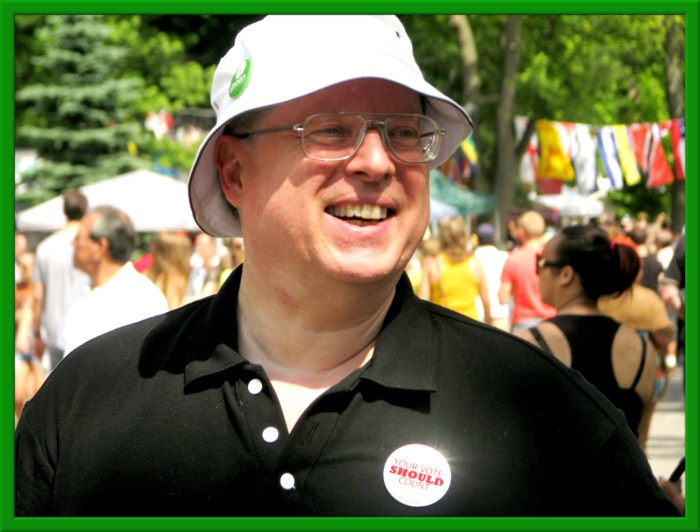
Candidates Nick Wendler (#KitCen) and Bob Jonkman (#KitCon) at the 2015 WRGreens Booth
Candidates Nick Wendler (#KitCen) and Bob Jonkman (#KitCon) the K~W Multicultural Festival WRGreens Info Booth (2015)
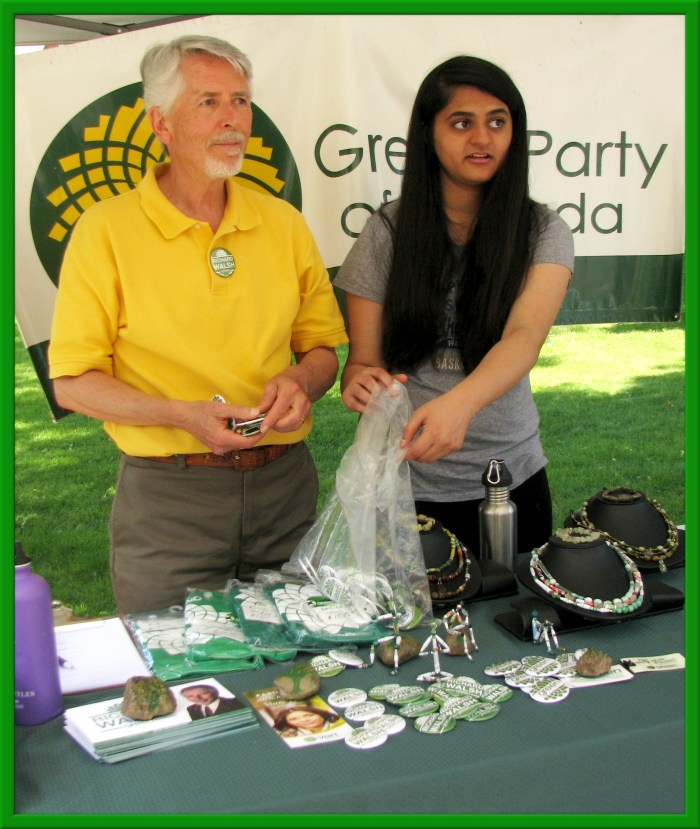
Candidate Richard Walsh (#Waterloo)
Candidate Richard Walsh (#Waterloo) dispenses Green Party buttons at the 2015 K~W Multicultural Festival
Laurel & Laura "We Can Do It"
Laurel & Laura “We Can Do It”
Bob Jonkman (Kitchener-Conestoga)
WRGreens were selling Heritage Tomato seedlings last year.
WRGreens are always happy to talk about Green issues.
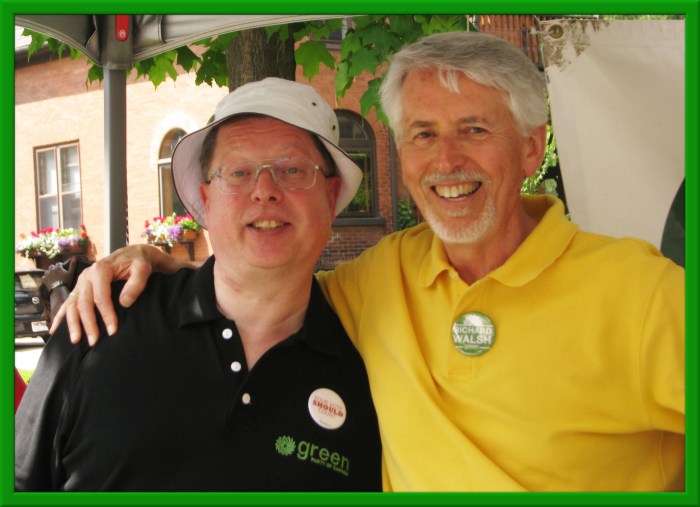
2015 #GPC Candidates Bob Jonkman and Richard Walsh


Visit us at Tri-Pride 2016

TRIPRIDE

Awesome Happens Here!

Visit the Waterloo Greens Info Booth!

Sunday, June 5,
1pm – 5pm
Kitchener City Hall

The Waterloo Region Greens kick off the summer festival season with an Infon Booth at the awesome Kitchener Tri-Pride Celebration.  Hope to see you there!

Want Electoral Reform? Sign a Petition for Elizabeth May

Sign the Declaration of Voter's Rights

Canadian citizens demand the following basic democratic rights:
– To cast an equal and effective vote and to be represented fairly in Parliament, regardless of political belief or place of residence
– To be governed by a fairly elected Parliament where the share of seats held by each political party closely reflects the popular vote
– To live under legitimate laws approved by a majority of elected Parliamentarians representing a majority of voters
The need for reform is urgent, and Canadians need a Parliament that represents the political and social diversity of Canada.

You can sign the petition online

or

You can download and print your own copies of the petition that you can mail to Elizabeth May when you’re done. I know it will be nice to have paper copies of the petition at the WRGreens information tables we’ll have in the upcoming summer festival season.

Subject: Sisson Mine Project, Registry # 63169

wetlands
wetlands

Today (Friday 13 May, 2016) is the last day the public can weigh in on this awful open pit mine project.

Canada’s First Nations peoples have always stood up in defense of the land; it is important that all Canadians do our part. I’ve just got the information, which I dressed up into this very long submission.  If I wasn’t sharing this with you here, I would probably have picked one or two things and made a much shorter submission, but since I’m sharing this here I decided to load up the whole works.  Submissions don’t have to be long and complicated; feel free to make use of this.


sissonproject@ceaa-acee.gc.ca

Catherine.McKenna@parl.gc.ca

Subject: Sisson Mine Project, Registry # 63169

To: The Canadian Environmental Assessment Agency and The Honourable Catherine McKenna

I am pleased to raise my voice in support the Maliseet First Nations who rightly oppose the proposed open-pit mine because of the terrible impact it will have on them and the environment. As big as Canada is, we simply can not afford the risk of environmental contamination we know will result from the Sisson open pit mine.

Since the Canadian government has finally endorsed the United Nations Declaration on the Rights of Indigenous Peoples it is unthinkable that a project that will so dramaticaly interfere with Maliseet First Nations people’s right to traditional use of crown land would even be considered.

Please heed the serious concerns of the Canadian citizens of the Maliseet First Nations. Don’t put the commercial interests of a private mining corporation ahead of the well being of Canadians and our environment. Government should seek to protect public health and safety, to ensure that the lives o citizens are not negatively impacted and/or endangered by a project like this open pit mine so fraught with risk. More and more people around the world are realizing that jobs aren’t any good if you can’t breathe the air or drink the water or grow food it is safe to eat.

The Sisson open-pit mine project is predicted to result in the loss of land (approximately 1,253 hectares), and residual impacts on resources used by Maliseet and Mi’gmag First Nations for traditional purposes.

The possibility of even a handful of the potential risks identified in the CEAA’s own report on the Sisson mine should be enough to halt this project.

The Canadian Environmental Assessment Agency (CEAA) report on the open pit mine reveals:

  • negative effects on the atmospheric environment from emissions such as dust, odour, noise and vibration;
  • water quality degradation as a result of seepage (beween 130 and 170 litres per second!) from the tailings storage facility and release of water from the water treatment plant (i.e. increased concentrations of trace metals);
  • changes in water quantity and flow regimes as a result of water retention and discharges;
  • effects on fish and fish habitat including the direct and indirect loss of habitat;
  • fish would be lost,
  • effects on wildlife, including species at risk, from ingestion of contaminants, sensory disturbance, and habitat loss;
  • direct loss (destruction) and changes in the function of wetlands, including removal and alteration of habitat supporting avian species at risk;
  • people intermittently using the project area for hunting, fishing, trapping, and other activities may be exposed to elevated levels of contaminants in the atmosphere, drinking water, or in harvested foods
  • effects on human health from consumption of country food and water impacted by project emissions and discharges;
  • the tailings pond would seep into the surrounding environment,
  • water contaminated through mine contact and processing on the site would be discharged downstream,
  • that waste rock would generate acids,
  • local fresh-water resources would be used in the various processes on the site,
  • negative effects on the current use of lands and resources for traditional purposes by Aboriginal persons including hunting and fishing,
  • negative effects on archaeological resources; and
  • and that hazardous materials would be stored there to the extent that Emergency Response Plans would be required.

The CEAA concludes the Project is likely to result in significant adverse environmental effects on the current use of lands and resources for traditional purposes by Maliseet First Nations. Only a limited number of large contiguous Crown land blocks, particularly along the Saint John River valley, remain available to practice current uses for traditional purposes proximal to the Maliseet communities of Tobique, Kingsclear, Woodstock, and St. Mary’s First Nations. Within the remaining Crown land blocks, use by these First Nations is limited by other existing land uses. Given this context, the Agency concludes that the environmental effects of the Project, in combination with the cumulative environmental effects of other projects and activities, on the current use of lands and resources by Maliseet First Nations are also likely to be significant.

Health Canada, Maliseet First Nation and Mi’gmag First Nation have all asked for more samples to be collected showing pre-existing “baseline concentrations of potential contaminants in fish, wildlife, and vegetation.” The Ministry of Environment and Climate Change Canada asked “the proponent to commit to follow-up studies of metal concentrations in wildlife species important to resource users and First Nations.”

And yet, according to the CEAA report, the proponent stated that “no further monitoring was warranted.”

The mining company’s consultants neglected to include arsenic in the non-carcinogenic risk evaluation, even though they admit arsenic concentrations may increase in local surface waters.

There is also no known solution to the risk of increased boron concentrations in fish tissue. We know evaluating trace metal impacts on human health after it occurs is not in keeping with the precautionary principle of avoidance, rather than insufficient mitigation and post-tragedy studies.

That the mine consultants “predicted a total tailings storage facility seepage rate between 130 and 170 litres per second and losses from the seepage collections system to groundwater between ten and 30 litres per second during operations” it is clear harmful water will not be under control on site

There are a lack of air quality monitoring commitments from the mine

In light of all of these things, it is grossly irresponsible to burden citizens with the responsibility of proving harmful water impacts have been caused by the mining company before investigation and mitigation by the proponent would occur.

The wishes of the First Nations communities opposing the Sisson mine must be respected; this project must not be given approval.

Sincerely,
Laurel L. Russwurm


Postscript
Additional Information about this Environmentally dubious project, courtesy of Ute Schmid Jones
http://www.conservationcouncil.ca/sisson-mine-project/

The latest on the Sisson Mine Proposal: An open-pit mine in the heart of upper Nashwaak River valley
The Conservation Council of New Brunswick: Department of Environment and Local Government PDF Public Comment on the EIA Report of the Proposed Sisson Brook Mine, Project #1172

What they are mining:
Tungsten
https://en.wikipedia.org/wiki/Tungsten
Molybdenum
https://en.wikipedia.org/wiki/Molybdenum

Fixing Canada’s Democracy ~ Making Every Vote Matter Petition

The Liberal Promise:

To make sure that every vote counts, the Government will undertake consultations on electoral reform, and will take action to ensure that 2015 will be the last federal election conducted under the first-past-the-post voting system.
Justin Trudeau, Speech from the Throne
December 4, 2015

What’s wrong with our current voting system?

While proponents [of the current system] often speak of the system as having the virtue of local representation, in fact representation is restricted to those who happen to vote for the winning party. Again, we think of this as normal—one alternative, known as proportional representation, is often derided as having been designed for “losers”—when a moment’s thought should reveal how arbitrary it is. Why should only the “winners” be represented in a democracy? The point of an election, surely, is to represent the people—all the people, not just some of them.
Andrew Coyne
The Walrus, October 2015

Why is proportional representation the best solution?

In countries where it has been introduced, it tends to reduce partisanship by promoting more collegial cross-party law-making. It helps to increase voter turnout, because people no longer see their votes as “wasted.” It ensures that representation from a region is not dominated by monolithic blocks of MPs from a single party…which completely distorts the diversity of perspectives of those populations. And it boosts the representation of women and of marginalized groups in Parliament…
Craig Scott
Maclean’s Magazine, December 2014

…and you’re sure the current system is broken?

YES!!!In contrast to many other systems, the Canadian provides very few checks and balances on a prime minister with a majority. The unelected Senate is a wet noodle; the government backbenchers are yes-men; the cabinet members are appointed by the top dog. With a couple of exceptions, none would dare stand up to such a domineering leader and controlling staff.
Jeffrey Simpson
The Globe and Mail, 2015

…and you’re sure PR is the way to go?

YES!!!Countries that count votes, not seats, tend to enact policies that are less homophobic and less racist. They have lower incarceration rates and are less interested in “law and order” approaches to crime. They wage war less often and get out of wars in which they do engage faster. They spy on their citizens less. They protect the environment better, embrace renewable energy faster and have more success reducing CO2 emissions. Forbes recently gave all five top spots for “Best places to do business 2015” to PR countries…
Patricia Lane
rabble.ca


Prime Minister Trudeau promised that 2015 would be the last first-past-the-post election in Canadian history, and that every vote would count in our next election. This is our one chance to fix Canadian democracy for good — add your name in support of proportional representation.

Please go to http://www.greenparty.ca/en/democracy to sign this petition.

And share 🙂

Divest Waterloo presents Gordon Laxer at the KPL

WRGreen folk may be interested in Divest Waterloo‘s presentation:
Gordon Laxer: After the Sands: Energy and Ecological Security for Canadians
Wednesday April 6th, 2016
@ 7:00 pm – 8:30 pm
at the Kitchener Public Library ~ 85 Queen St N, Kitchener, ON, Canada N2H 2H1

KWPeace writes:

Gordon Laxer
is coming to KW to give a public lecture on his new book, After the Sands: Energy and Ecological Security for Canadians.

Impeccably researched, After the Sands is critical reading for anyone concerned about rising sea levels, pipeline and tanker spills, climate change chaos and Canada’s future in a carbon restricted world.

Ralph Nader hails it as “a myth-destroying blockbuster book.”

The talk will be followed by responses from the community to relate Laxer’s work to local struggles and opportunities.

Where: Kitchener Public Library, Central Library Theatre, 85 Queen Street North, downtown Kitchener [Map]
When: Wednesday, April 6th, 7:00–8:30pm (note that community groups will have information tables outside the theatre starting at 6:30)

The event is free and open to the public—everyone is welcome!

Please register here: afterthesands.ticketfi.com

This event is hosted by the Department of Political Science with support from numerous campus and community groups including the Kitchener Public Library, the Waterloo Aboriginal Education Centre, the School of Environment, Resources and Sustainability, the Balsillie School of International Affairs, Sustainable Campus Initiative, Waterloo Political Economy Group (WatPEG), Waterloo Public Interest Research Group (WPIRG),ClimateActionWR, the Council of Canadians (Guelph and Centre Wellington Chapters), Divest Waterloo, and KAIROS. Wordsworth Books and Hacienda Coffee folks will be on hand with books for sale and treats to share!

BREAKING: Gordon Laxer was just named as a finalist for the John W. Dafoe Book Prize for non-fiction stories on Canada.

NASA: Athabasca tar sands environmental impact 1984 vs 2011
NASA: Athabasca tar sands environmental impact 1984 vs 2011 (Public Domain image)