Ontario’s Basic Income Pilot: public survey

One of the most important Green Party of Canada campaign issues was the Guaranteed Livable Income.  The idea was piloted in Canada under the name “Mincome” under the first Prime Minister Trudeau.   What happened then is what happens all to often… the government fell and its successors had no interest in implementing policy based on their predecessor’s pilot project.   Here in Waterloo Region, we have our own Basic Income Waterloo Region advocacy group that’s part of a Canada-wide grassroots movement to make a basic income guarantee the next great innovation in social policy.

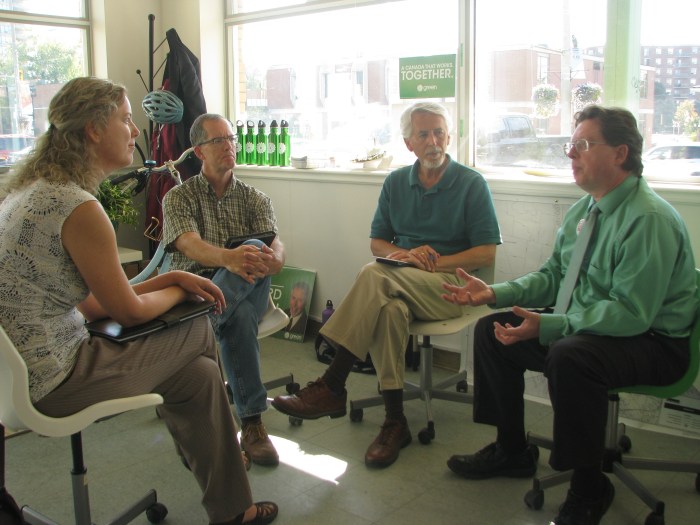
Basic Income Waterloo meets with Richard Walsh and Bob Jonkman at the Waterloo Greens Office during the 2015 election
Basic Income Waterloo meets with Richard Walsh and Bob Jonkman at the WRGreens 2015 campaign office.

The Ontario Liberal Government is considering running its own pilot program, and it would be enormously helpful to fill out their

Basic Income Pilot: public survey

While on the surface it may seem that such a program would be prohibitively expensive, ironically research shows the effect of a properly managed basic income guarantee is actually a savings to government, as well as a boost to small business and innovation.  Check out Basic Income Waterloo Region’s Frequently Asked Questions page.

.

The #WRGreens want some #ERRE

WRGreens Community Dialogue poster

In Waterloo Region, as in most of Canada, although there is support for the Green Party, there are no elected Green MPs.  This does not mean there is no support for the Greens, it just means there isn’t enough support to elect many Greens when votes cast for Green Party Candidates aren’t as powerful as votes cast for bigger parties.  That’s what’s wrong with Canada’s electoral system in a nutshell:

Some votes count more than others,
but most votes don’t count at all.

In spite of the grievous unfairness of Canada’s winner-take-all electoral system, there are Green supporters all across Canada.  And while the dropping vote share for Green candidates seems to suggest the party is losing support, the reverse is true.  Unfortunately all too often, too many would be Green voters chose to vote strategically for a candidate they don’t actually want to elect, to prevent one they really hate from winning the seat.  This isn’t just bad for the Green Party, it’s bad for all Canadians, because the parliament that results fails to reflect the intentions of most voters.

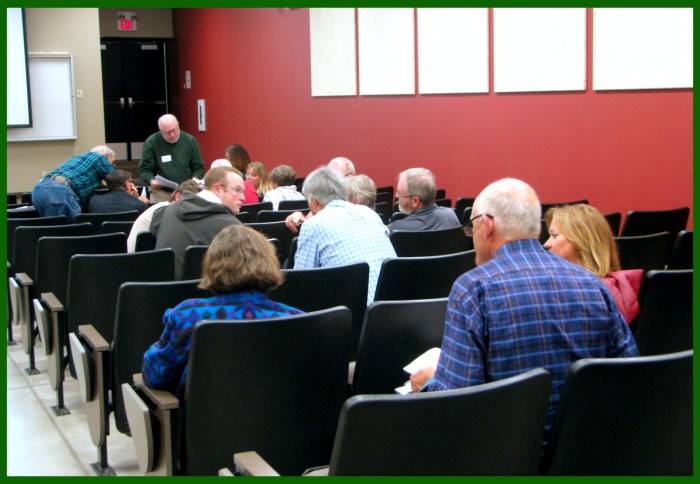
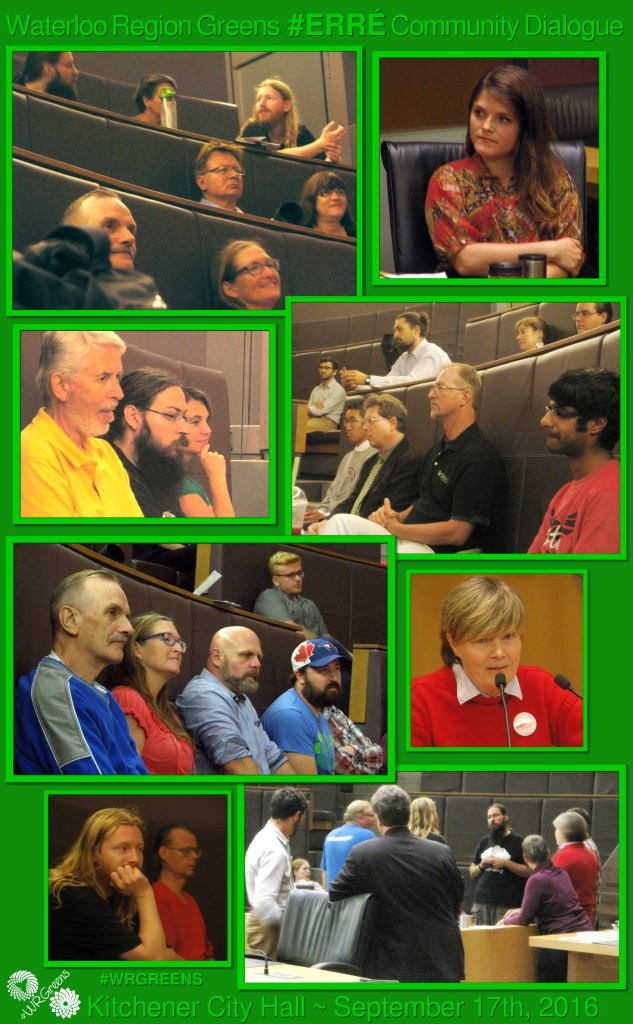
Even though we have no Green MP in Waterloo Region (or even Ontario), we held our own Community Dialogue.  Ours was not a partisan event, and we did attract non-Greens, but it shouldn’t be surprising to anyone that an overwhelming majority of those in attendance supported adopting some form of Proportional Representation.

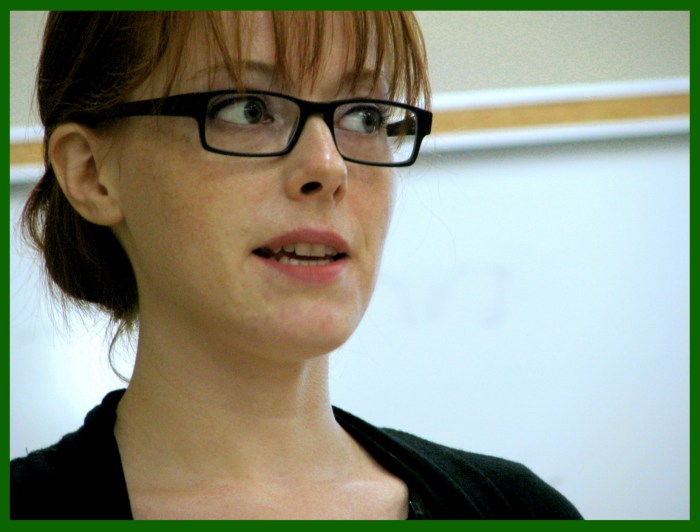
One young woman in my small group dialogue told us that her 2015 vote had actually elected someone for the very first time.  But instead of making her feel good, it left her feeling hollow because now she has an MP she didn’t want that she helped elect.  When our votes don’t count, how can anyone count on getting the government policy we want?
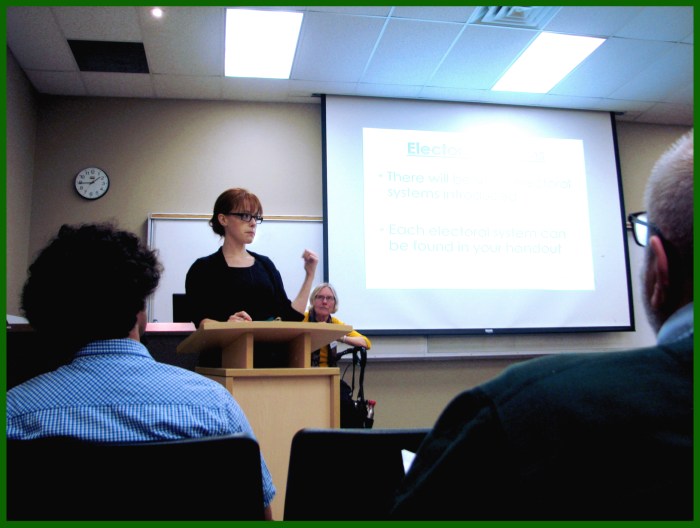
Temara Brown explains electoral systems

A group of Liberals in the Conservative Brantford-Brant held their own multipartisan Community Dialogue Event, inviting our own Temara Brown to participate.  And the sitting Conservative MP attended as well.

One good thing is that a majority of Canadian voters (that is to say, those sixty-something % of eligible voters who voted) voted for candidates and parties that supported electoral reform.  Since the Liberals promised an end to First Past The Post elections, and Mr. Trudeau promised to make every vote count, we’ve had a whirl wind Parliamentary electoral reform Consultation.  Thousands of Canadians have participated across Canada, and everything we hear suggests predominent support for Proportional Representation.

And now the all party ERRÉ (Electoral Reform Reforme Électorale) Special Committee on Electoral Reform has begun deliberating over everything they’ve heard, from the experts as well as public input.  The problem is that comments made by Prime Minister Trudeau and Minister Monsef sound as though the Government is beginning get cold feet.  It is, after all, hard to get a government that won majority power with a minority of votes under a First Past The Post system to adopt a system of Proportional Representation that will limit their power to what they earn in votes.

Justin Trudeau's Liberal 2015 Campaign Promise: We will make every vote count

We need to encourage the ERRÉ Committee to work toward a truly fair system ~ and that can only mean some form of Proportional Representation.  We can let the ERRÉ Committee what we want by writing to them ourselves.  The folks at Fair Vote Canada have made this easier for us with their automated tool that will send a letter urging the committee to recommend PR.

http://fairvotecanada.good.do/thankyou/keepthepromise

NOTES:  Although it may look like it, you do *not* have to make a donation to Fair Vote unless you wish to.  After your message is sent just close the browser tab.  If you choose to use the FVC tool, bear in mind doing so will give Fair Vote Canada your contact info.  [Every time you give anyone your contact info online there is always a chance they will keep it so they can contact you in future.  If you are concerned about these things, you can still borrow useful bits from their letter and make your own that you send directly to:

Postal Mail:
Special Committee on Electoral Reform
Sixth Floor, 131 Queen Street
House of Commons
Ottawa ON K1A 0A6
Canada

E-mail: ERRE@parl.gc.ca
Fax: 613-947-3089
Website: parl.gc.ca/ERRE-e

The best part is we don’t have to send Fair Vote’s letter.  You can start with it, or edit it to say whatever you like, or start completely from scratch.  No matter how you choose to get it done, it certainly can’t hurt to remind the Committee and the Government that we are still watching, and, more importantly waiting to see what Canadian Proportional Representation will look like.
Answers to the Canadian Taxpayers Federation Petition

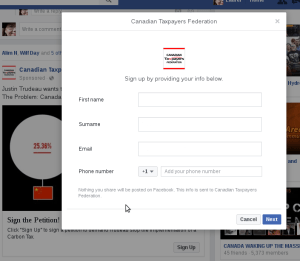
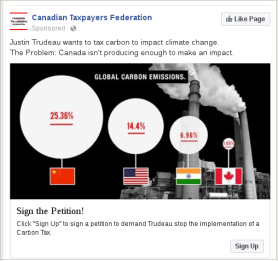
Canadian Taxpayers Federation ad in my Facebook feed says:

Justin Trudeau wants to tax carbon to impact climate change.
The Problem: Canada isn’t producing enough to make an impact.
Sign The Petition!
Click “Sign Up” to sign a petition to demand Trudeau Stop the Implementation of a carbon tax.

I was curious to see what the Petition actually said, so I did click on the link.

Canadian Taxpayers Federation Petition
But instead of a petition,
screenshot-2-facebook-opera
what popped up was an attempt to harvest my personal data.

astroturf

I guess I shouldn’t be surprised after reading the recent CBC article, “Canadian Taxpayers Federation has 5 members — why should we care what they think? that busts the Canadian Taxpayers Federation as astroturf (a fake “grass roots” organization).

Even so, lots of people are going to read this and be misled.
A look at the top of the comments gave me a couple of excellent rebuttals:

Dave Urquhart writes:

Canada is home to 0.56% of the population.

If you do the math, we’re emitting at a level 3 times greater than the average of the rest of the world.

If you take into consideration that emissions stay in our atmosphere for millennia, the 1.65% number isn’t even close to what our contribution has been toward climate change. It will take a world war mobilization type effort to avert runaway climate change.

I don’t agree with a cap and trade system, and believe that the generous subsidies that we provide for the fossil fuel industry should be eliminated as well, but a price on carbon will be required to get the masses out of their emissions comfort zones. The tax amounts to 2 cents a litre in the first year and only 11 cents in the last year. We seem to have been able to handle those kinds of increases in the past without substantial hardship. You will be affected far less if you reduce your emissions, that’s what the tax is intended to do. Or is it easier to throw others (who are geographically and financially more vulnerable) under the bus? The mindset that got us into this mess, certainly won’t get us out of it. It’s time to move away from the use of fossil fuels – if we do that – there will be no burden from the tax.

Like Dave Urquhart, my preference is not for Cap and Trade.

Michael Nabert writes:

When the largest collective scientific effort in human history tells us that we clearly need to be shifting away from fossil fuels as rapidly as possible, the best the Canadian Taxpayers Federation has to offer is the equivalent of my college roommates letting the dirty dishes pile up in hopes that someone else will wash them first.

Let’s look at the numbers to see how well the “we’re such a small part of the problem that we’re not worth bothering with” argument stands up to logic. Canada is the 8th largest emitter in the world, and has contributed more to combined historical emissions than all but seven other nations. With less than half of one percent of the global population, Canada emits 1.67% of the world’s greenhouse gas emissions.

http://www.statista.com/statistics/271748/the-largest-emitters-of-co2-in-the-world/

Canada has 0.475% of the world’s population. That means that of total current global emissions, Canada takes up 3.52 times our fair share of a number that is collectively far too large to begin with. That number is also clearly artificially low because the way it is calculated leaves out a number of glaringly obvious considerations. In any honest assessment we also bear responsibility for emissions from factories that were offshored in order to slash wages but that are still producing products exclusively for sale in North American markets, because that’s our stuff and therefore clearly our responsibility. Canada is also responsible for the emissions resulting from burning the roughly 5% of global fossil fuel exports that come from us. So we’re emitting several times more than our fair share. Any argument that Canada should not act is, by definition, irresponsible.

If we look at a more honest per capita measurement, we can see that the average Canadian is causing more than twice as much harm to the planet than the average Chinese citizen (typically the first direction fingers are pointed). China has increased the strength of its climate commitments aggressively several times in recent years. China is also well on its way to meeting or even exceeding its targets. Canada, on the other hand, not only has spectacularly weak emissions targets compared to the other industrialized nations, we are in no way even going to come close to meeting those targets. Here’s another comparison: China is investing 1% of its per capita income into renewable energy. Canada is investing 0.19% instead, making less than one fifth as much effort to move away from fossil fuel use.

Finally, there is a level of absurdity about overseas finger pointing. I don’t have the opportunity to lobby the governments of Saudi Arabia or China to change their oil policies, but even if they do the right thing and stop producing oil, our continuing to do so willy nilly would still be roasting our loved ones. Canadians do have the ability as well as the responsibility to impact emissions here at home.

http://www.statista.com/statistics/271748/the-largest-emitters-of-co2-in-the-world/

And that takes care of that.


Image Credits:

Canadian Taxpayers federation images used under education/criticism Fair Dealing exemption

Astroturf graphic by @laurelrusswurm is a remix of “Skagerak Arena turf” © by Rune Mathisen [bitjungle on Flickr] is released under a Creative Commons Attribution-Share Alike 2.0 License.

An Enemy of the People

Waterloo Greens’ Richard Walsh is mounting a local production of a play about whistle blowing in a Water-Safety Crisis.

richard-walsh
Richard Walsh
2015 Green Party Candidate in Waterloo

Although this is not a Green Party event, even if our esteemed colleague Richard was not involved in this production, the issues of whistleblowing, water, public accountability and the environmental certainly fall within the bounds of green interest.

Many of us remember incidents of severe water contamination in  Grassy Narrows,  Walkerton,  Elmira, Ontario, and  Flint, Michigan.

Do you also remember how some municipal and provincial or state authorities and local businesspersons tried to cover up the dangers to residents’ health?

That’s what the next theatre production by Christ Church Waterloo is all about: environmental and moral responsibility.

On November 10th-12th at 8 pm Christ Players presents in the sanctuary Richard Walsh’s adaptation of Henrik Ibsen’s original 1882 drama, An Enemy of the People.

Richard has set the play in Canada 2016, abbreviated it, modernized the language, and incorporated audience participation. As well, after each performance audience members can participate in group discussion about the issues the play raises.

In the play the main character, “Dr. Thomas Stockmann,” who is his town’s Medical Officer of Health, discovers that the source of water for the town and its new healing baths is dangerous to use. He sets out to overcome cowardice and deception by the powers-that-be in the face of this crisis in public health. Despite his political naiveté, Thomas bravely challenges the town’s status quo for what he believes is the greater good. However, like all the characters in the play, he has personal flaws that make his attempts to resolve the dangers to his community difficult to achieve.

An Enemy of The People
November 10 – 12, 2016
8:00 pm

Christ Lutheran Church
445 Anndale Road, Waterloo

Tickets ($15 for adults, $10 for students) may be ordered in advance from the church office @ 519-885-4050.
Seating, which is general admission, is limited to 100 per performance.

(As this production contains some coarse language, it’s suitable for students from Grade 7 onwards.)All proceeds will be directed to the church’s community-outreach programmes.

"Enemy of the People" poster

Fee and Dividend vs. Cap and Trade

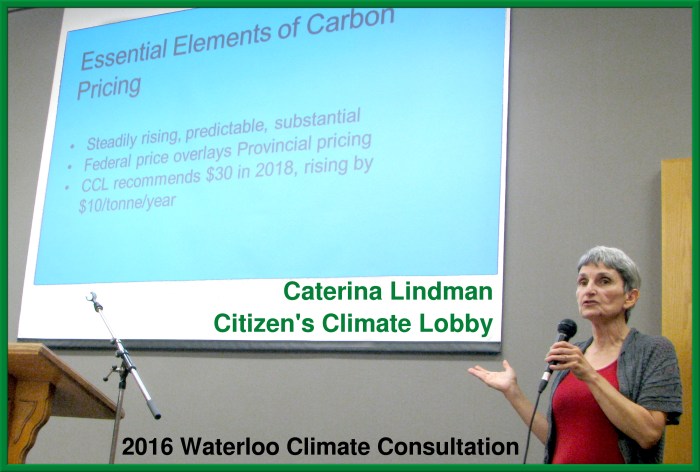
Caterina Lindman represented the Citizen’s Climate Lobby at the Waterloo Region Climate Consulation at Kitchener City Hall in August.  CCL is a strong advocate for the Fee and Dividend carbon tax; which is why one of the things she spoke about was the CCL recommendation to begin with a $30 per tonne carbon tax in 2018, with annual increases of $10 per year.

Caterina Lindman (Citizens Climate Lobby) speaks to discussion facilitators at the Waterloo Region Climate Consultation, August 18th, 2016

Earlier this month the Canadian Government announced its plan to implement a Carbon tax.

“It will start at $10 per tonne and increase by $10 each year, up to $50 a tonne by 2022. Trudeau added that the tax will be revenue neutral for the federal government. Proceeds from the tax will be returned to the provinces where they were collected.

“Trudeau said that details regarding implementation will largely be left up to the provinces. Each jurisdiction should decide on whether they want a cap-and-trade system (the sort of scheme favoured by the Obama administration) or a direct price on greenhouse-gas emissions (like with B.C.’s system for taxing air pollution).”

— Justin Trudeau announces national carbon tax will begin at $10 per tonne in 2018 and rise from there to $50

Although we are pleased Canada finally understands the need for a carbon tax, we would be much happier if the initial figure were higher.

The other issue is the federal Government’s failure to insist on the use of a Carbon Fee and Dividend plan instead of leaving it up to the provinces.

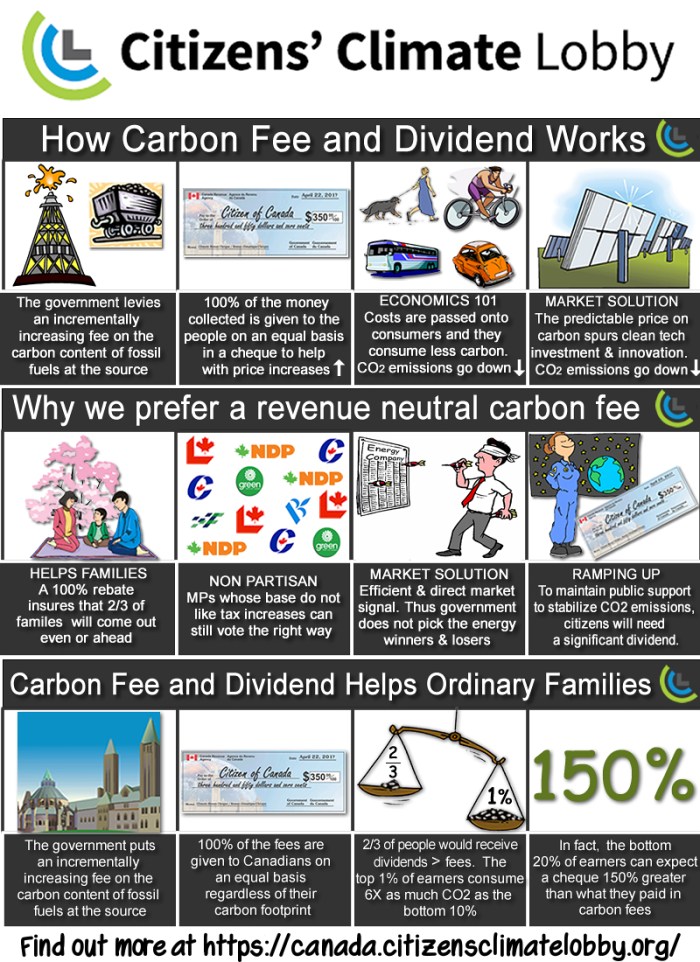
Let’s let this wonderful graphic created by CCL to explain why Fee and Dividend is the best option:

CCL Fee and Dividend infographic
Citizen’s Climate Lobby Canada explains How Carbon Fee and Dividend works.

Although it also puts a price on carbon, Cap and Trade works differently, more like a game of monopoly that allows wheeling and dealing with carbon emissions. Evidence from elsewhere demonstrates that it doesn’t really work, let alone foster a transition from carbon to sustainable energy.  There is also growing evidence Cap-and-trade? Not so Great if you are Black or Brown.

Although it sounds lovely that the plan is revenue neutral to the Federal Government, but not if it becomes a cash cow to the provinces.  But perhaps worse, instead of being revenue neutral, the carbon tax funds collected are not distributed among the people, it becomes a source of government income.

Can you remember the last time a government willingly gave up a source of revenue?

Me either.

Our Californian friends can tell us: Why fee and dividend is better than cap and trade at fighting climate change.  Although it is not enough, even a weak carbon tax is a baby step in the right direction.

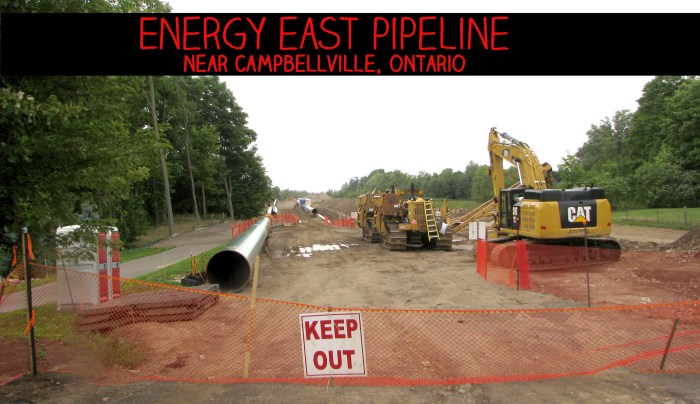
Energy East Pipeline

You can’t, however, say the same about fossil fuel pipelines.


Credits
Explainer video and Fee & Dividend Infographic by Citizen’s Climate Lobby
E
nergy East Pipeline and Caterina Lindman photos by Laurel Russwurm, released under a Creative Commons Attribution License


Cross Cultures Town Hall with Dimitri Lascaris

[Guest Post by Gehan Sabry of Cross Cultures]Cross Cultures Interactive Town Hall with Dimitri Lascaris poster

Join Cross Cultures for a lively interactive town hall with Dimitri Lascaris who will address

* OUR FREEDOMS
* DISSENT
* B D S

Cross Cultures encourages everyone— especially those who disagree — to come and give their perspective…

… that is how we dialogue and that is how we promote mutual respect and understanding 

… not by suppressing, censoring or avoiding sensitive issues …

All attempts to invite a speaker whose views are anti BDS to provide the counter point of view have been declined.

Dimitri Lascaris
dimitrylascarisis a lawyer called to practice in Ontario and New York State. After working in the New York and Paris offices of a major Wall Street law firm, Dimitri became a class action lawyer in Canada. His class actions practice focused on shareholder rights, environmental wrongs and human rights violations.
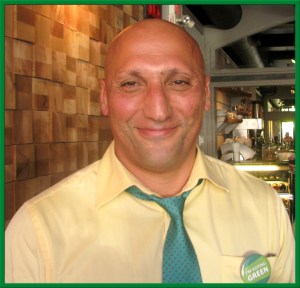

In 2012, Canadian Lawyer Magazine named him one of the 25 most influential lawyers in Canada, and in 2013, Canadian Business Magazine named him one of the 50 most influential persons in Canadian business.

Until recently, Dimitri was the Justice Critic in the Green Party of Canada shadow cabinet. He is the author and submitter of the Green Party of Canada’s BDS resolution

“I am very happy to announce that, for our BDS town hall at the University of Waterloo on October 17, I will be joined by two extraordinary women, Rehab Nazzal and Wendy Goldsmith.

“Rehab is a Palestinian-born multidisciplinary artist and educator based in Toronto and Bethlehem. Her video, photography and sound works deal with the violence of war and settler colonialism, and have been shown in Canada and internationally. Recently, Rehab was shot in the leg by an Israeli sniper while documenting the noxious activities of Israeli skunk trucks in occupied Bethlehem. 

“Wendy is social worker and mother of three from London Ontario. As a social worker she has worked with many marginalized and traumatized individuals, families and communities and began her work in Palestine after Operation ‘Cast Lead’ and saw through photos and direct accounts of the horror and devastation inflicted by Israel on Gaza. Wendy is a member of the steering committee of Canada Boat to Gaza, a representative at Freedom Flotilla Coalition and on the Media team for the Women’s Boat to Gaza. Wendy recently returned from Barcelona, Spain, Ajaccio, Corsica and Messina, Sicily where she participated in the sailing of the Zaytouna.

“It is an honour for me
to speak about the
GPC’s BDS resolution
with Rehab and Wendy.”

— Dimitry Lascaris

This event is open to the public.

WHEN: 6:00pm
Monday, October 17th, 2016

uniWHERE:
Psychology Anthropology Sociology Building
PAS room 2083
200 University Ave West,
Waterloo, ON N2L 3G1
(~MAP~)

Why Online Voting is a Bad Idea for #ERRE

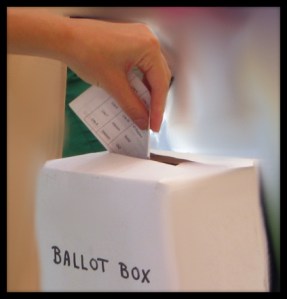
ballot-boxComputer security people will be able to tell you:

You can have a secret ballot OR a secure system, but not both. Internet banking and commerce can be secure, but only because the bank knows who the customer is.

Fair Vote Waterloo says:
On Referenda, Consultations, and Postcards

Australian Computer Expert Vanessa Teague:
Election explainer: why can’t Australians vote online

Daily Dot takes a much more technical look:
Online voting is a cybersecurity nightmare

“The” computer security expert, Bruce Schneier agrees:
More Voting Machine News

Barbara Simons asks: Why can’t we vote online?

Online voting is one of the things Canada’s ERRE Special Committee on Electoral Reform has been tasked with studying, so WRGreens own Bob Jonkman framed this important issue in the Canadian context in his Submission to the ERRE Consultation:

“I am opposed to electronic voting and online voting. I am a computer consultant by profession, and nothing I see in my work shows that people’s home computers or even the computers in most businesses have the security capable of upholding the Integrity requirement, ensuring reliable and verifiable results.

“The main issue with online voting is not computer security, but a fundamental incompatibility between voter identity and the secret ballot.

“When voting takes place outside of a polling station it is important that voter identity is established to prevent fraud. It must be provable that the ballot filled in online was actually filled in by a registered voter, and not by someone impersonating that voter. To achieve this, voters need to be issued a ballot with a serial number or barcode to ensure that only that one ballot is filled in for that registered voter. But if every ballot cast has a serial number, then the completed ballot with the voter’s choices is identifiable with the voter’s name and registration information. The secret ballot is impossible, and the Integrity criterion cannot be met.

“When voting does not take place in a polling station then it is possible that a voter will be coerced into voting according to the demands of the “head” of the household, or voting at the workplace according to the employer’s demands. Without the scrutiny of Elections Canada, voting integrity cannot be ensured.

“But computer security is an issue too. People’s personal computers are constantly being attacked by computer viruses, malicious web sites, and denial of service attacks from compromised Webcams. And spam. The difficulty of ensuring online voting integrity is at least as great as is the difficulty of eliminating spam (unsolicited, unwanted e‑mail, sometimes commercial in nature, sent in bulk). If you haven’t experienced problems with spam then it is likely your E‑mail Service Provider is filtering your e‑mail for you – but how many good messages are being filtered accidentally? You’ll never know, because you’ll never see them.

“There are actually very few large-scale spammers on the Internet, maybe a couple of dozen at most. But they’re responsible for almost all the unwanted e‑mail that clogs up billions of e‑mail accounts in the world. It shows how a few bad actors on the Internet can completely overwhelm an e‑mail system. Similarly, a few bad actors on the Internet can completely compromise an online voting system. If we can’t secure our mail systems to solve the spam problem, it is unlikely that we’ll be able to secure everyone’s computer to guarantee online voting integrity.

“It is unfortunate that there were so few computer security experts providing witness testimony to the Committee. Almost every computer security expert who has commented on electronic voting since the U.S. “hanging chad” elections in 2000 has decried the use of voting machines, and, more recently, online voting. Voting machines are regularly compromised, are not auditable by design (they have proprietary source code), and are prone to failure when needed most. Computer security lecturers delight their audiences with tales of voting machine touch screens that dodge the target when the “wrong” vote is selected, or that play marching band music after they’ve been compromised by a prankish hacker.

“Voting is very much different from buying a product from an online store. If the wrong product is delivered, the store will ship the right product the next day to ensure customer satisfaction. But if the wrong candidate is elected, there is no recourse the next day. It is unlikely that fraud will be detected until the voting machines are audited many weeks after the election, and even when fraud is detected the outcome will be hotly contested by the affected candidates. In fact, if voting machines don’t use publicly published open source code then it is likely election outcomes will be hotly contested because proving that no fraud was committed is impossible.
Bob Jonkman working in the WRGreens office
“However, vote tabulation by machine is perfectly acceptable, although there must be a requirement that vote tabulators are also audited and their source code is made public. Ballots designed for vote tabulators (optical mark cards) can always be counted manually if the electronic tabulation is in dispute.”

— Bob Jonkman:  Electoral Reform — My Submission to the #ERRE Committee

Here’s hoping the #ERRE Committee puts Online Voting aside until it might be accomplished securely.

WRGreens visit Brantford-Brant Greens #ERRE

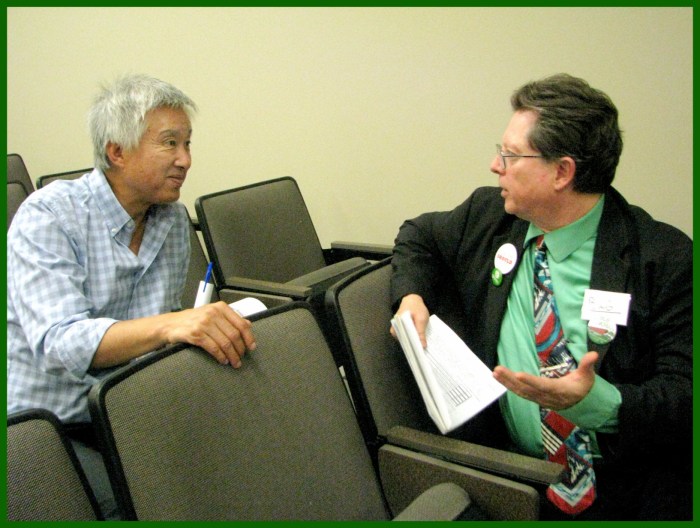
Greens in Brantford ~ Ken Burns, Temara Brown, Jason Shaw, Bob Jonkman ~ ERRE Community Dialogue

On Sunday, October 2nd the The Brantford-Brant Women’s, Youth and Seniors’ Liberal Clubs hosted the multi-partisan Brantford-Brant Electoral Reform Community Forum in the Odeon Building at the Laurier Brantford campus.

[Note: the CPC MP attended and spoke at the LPC event, and of course Greens were there by invitation as well.  Where was the NDP I wonder?]
Temara Brown explains electoral systems

Temara Brown described the six different electoral systems, a fairly difficult task, particularly when being challenged by unruly audience members at every turn.  But she carried it off. Temara Brown, Cambridge GPO
The event followed the usual Library of Parliament script for Community Dialogue suggested by ERRE.
Small Group Discussions
The Brantford Expositor covered the event in Forum puts spotlight on electoral reform

Bob Jonkman chats with LPC Ray Wong
Unfortunately there are some errors in the Expositor article. For instance, Michele Braniff was the 2015 GPC candidate.  As well as being a GPO Candidate, Temara Brown is the GPO’s Shadow Cabinet member for the Ministry of the Environment and Climate Change.

The article gives a capsule rundown of the 6 electoral Systems discussed, where the worst error in the article mischaracterizes the Single Transferable Vote (STV) system as “A variation of the preferential vote”.   Electoral systems are complex,  which is one of the many reasons why a referendum would be a bad idea at the best of times.

Historically, STV predates AV by a few decades, so it would be more correct to say AV is a variation of STV.  But that’s just semantics. The real problem is that STV is perhaps the best system of Proportional Representation, while AV is a winner-take-all system much like our First Past The Post.
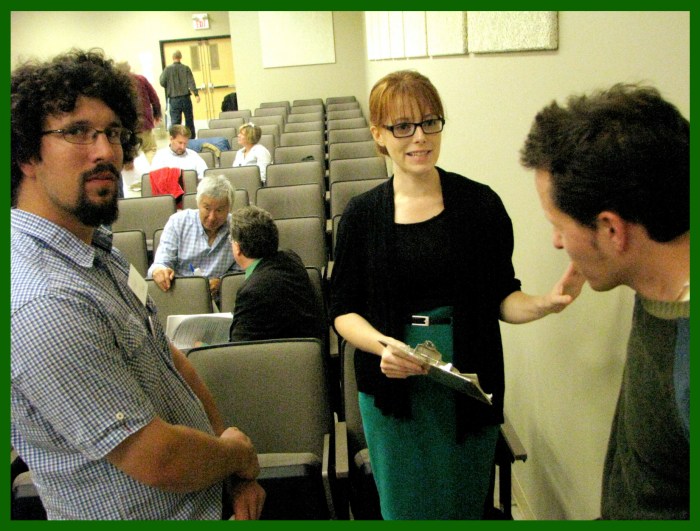
Post Community Dialogue dialogue, with Jason Shaw (FVC) and Temara Brown (WRGreens Cambridge)
Even so, it was nice to see some balanced coverage of the ERRE event.  For the most part, Canada’s Main Stream Media is making no bones about it’s desire to retain the status quo.  That is perhaps the biggest reason Canadians are so woefully uninformed about electoral reform options.  Instead of informing Canadians of our options, or even actually reporting on the ERRE consultation process, the media tables at ERRE consultation events are standing empty.  So kudos to the Expositor for reporting the news!


Ken Burns (Brantford-Brant candidate), Temara Brown (WRGreens Cambridge GPO Candidate), Jason Shaw (Fair Vote Canada) and Bob Jonkman (WRGreens Kirchener-Copnestoga and Fair Vote Waterloo)
Ken Burns (Brantford-Brant), Temara Brown (WRGreens Cambridge GPO Candidate), ________, ________, Jason Shaw (Fair Vote Canada) and Bob Jonkman (WRGreens Kitchener-Conestoga and Fair Vote Waterloo Co-Chair)

In spite of the Main Stream Media obstructionism, the process marches quietly on.

And a good thing, too.


Understanding Electoral Reform in Elmira

Waterloo Region Greens own Bob Jonkman will be presenting “Make every Vote Count” at the Elmira Branch of the Region of Waterloo Library, starting at 6:30pm, tomorrow night, Wednesday, September 21st, 2016.   In his capacity as co-Chair, Bob helped develop the Fair Vote Waterloo presentation, which starts with our existing electoral system as well as Canada’s electoral reform options.  There will be a question and answer session after the presentation.

Hope to see you there!

Next week there will be two more Information Sessions at the Region of Waterloo Libraries in New Hamburg and Ayr.

Wednesday,  September 28th, 2016 ~ 6:30 pm – 8:00 pm

img_9267New Hamburg Branch
145 Huron St
New Hamburg, ON N3A 1S3

Thursday, September 29th, 2016
6:30 pm – 8:00 pm

Ayr Branch
137 Stanley St
Ayr, ON N0B 1E0

Canada’s Voting System Is Changing

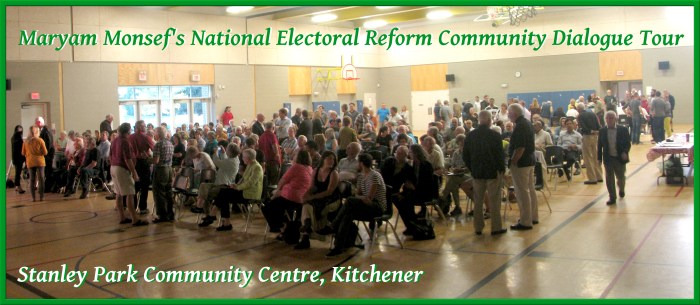
Stanley Park Community Centre - Maryam Monsef's National Electoral Reform Community Dialogue Tour

Maryam Monsef, Minister of Democratic Institutions“For the past month I’ve been traveling across Canada hearing from Canadians directly on the values and expectations they feel should be reflected in Canada’s electoral system.
At every stop, it is clear; Canadians expect greater inclusion, transparency, engagement and modernization from their public institutions.”

— The Hon. Maryam Monsef,
Minister of Democratic Institutions ~ Ottawa, ON, Sept. 15, 2016

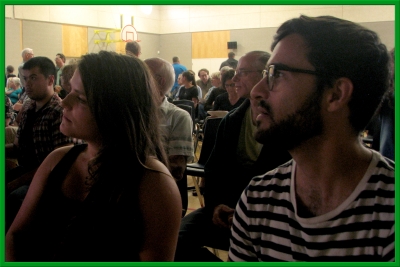
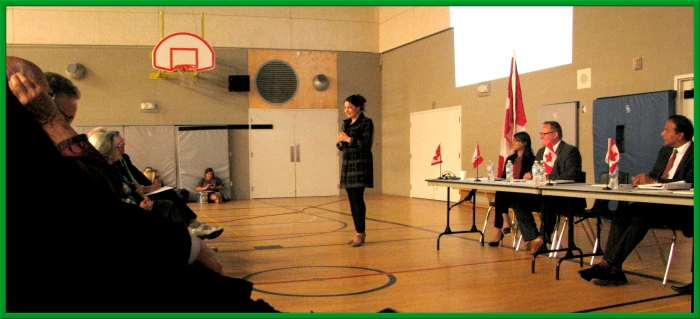
Hundreds of Waterloo Region residents crowded into the Stanley Park Community Centre on Wednesday night for a chance to participate in the Federal Electoral Reform Consultation with the the Honourable Maryam Monsef, the Minister of Democratic Institutions.  Ms. Monsef shared the stage with local LPC Mps, the Honourable Bardish Chagger, Bryan May, Marwan Tabbara and Kitchener Centre host, Raj Saini,  But the evening’s main course was the small group dialogues where participants considered issues and shared their views.  Each group came up with a series of conclusions, all of which were duly passed along for consideration in Ottawa.  The Record‘s Luisa D’amato reports:

As I felt the unmistakable sense of optimism that comes when a powerful person asks your opinion, it occurred to me that we might have got it wrong all this time.

We’ve asked young people to vote, and shook our heads when they didn’t. “Don’t complain if you don’t vote,” we said.

Yet the rules by which we held the elections seemed designed to silence their choices.

D’Amato: It’s heartwarming to see a packed room for electoral reform discussion

Julia and SamJulia and Sam (Kitchener Centre Greens) are passionate about meaningful electoral reform.  The shape of their future depends on it.  They’re the driving force behind our Canada’s Voting System Is Changing event at Kitchener City Hall tomorrow.
Canada's Voting System Is Changing poster
Canada’s Voting System Is Changing poster ~ click to download larger size

The main goal of tomorrow’s event is to provide public information about our options.

Every MP in Canada has been asked to consult with their constituents about what they would like to see in terms of electoral reform.  Although our evening with Ms. Monsef was excellent, it would have been nice to see 4 Liberal Town Halls.  Knowing how long it took me to get my head around electoral reform, more events might make it easier for many citizens.

Sadly Kitchener-Conestoga residents don’t get any Town Hall at all.  Our Conservative MP Harold Albrecht has declined to conduct a consultation.  Fair Vote Waterloo will be putting on 3 more Library Information nights at Elmira Library, New Hamburg and the Ayr Public Libraries.

Earlier in the year the Waterloo NDP put on an information event with Fair Vote Waterloo, but now it’s our turn.

Proportional Representation is not a partisan issue; it is simply a way to better represent citizens in Parliament.  This isn’t about parties, but about what is best for all of us, the voters.  That’s why each of these events have worked hard to put partisanship aside in order to both inform and converse with the public.

the Hon. Maryam Monsef, Minister of Democratic Institutions speaks to a packed house in Waterloo Region, Wednesday Night.
The Hon. Maryam Monsef, Minister of Democratic Institutions speaks to a packed house in Waterloo Region. September  14th, 2016

So many other countries have adopted meaningful electoral reform that there’s a lot of information out there. And yet, Canadians have heard almost nothing about the alternatives before us.

That’s why Fair Vote Waterloo co-chair Sharon Sommerville will give an introductory talk about Proportional Representation. Then we’ll break into small group discussions, much like Maryam Monsef’s National Electoral Reform Community Dialogue Tour the other night.   We have decided to have two kinds of groups; one to help those of us just beginning to learn about Proportional Representation, and another for those who have an idea of what kind of reform they would like to see.  The latter will be able to discuss the issue as a group in order to make a group submission we can forward on to the ERRE Committee.

Even if you have a pretty good handle on Electoral Reform, we look forward to seeing you in Carl Zehr Square.  It is always a lot more fun to work on a submission together, and it is amazing how much discussion can help clarify the things we’re fuzzy on.  The more Canadians participate in this electoral reform process, the better the outcome will be.

This is a perfect opportunity to help your friends and neighbors get the facts about electoral reform.  We hope to see you there!

Canada’s Voting System Is Changing: Community Dialogue
Saturday September 17th, 2016
3:00pm – 4:30pm

Carl Zehr Square, in front of Kitchener City Hall
200 King St W, Kitchener, Ontario, Canada map

RSVP on the Facebook Event:
Community Dialogue: Proportional Representation

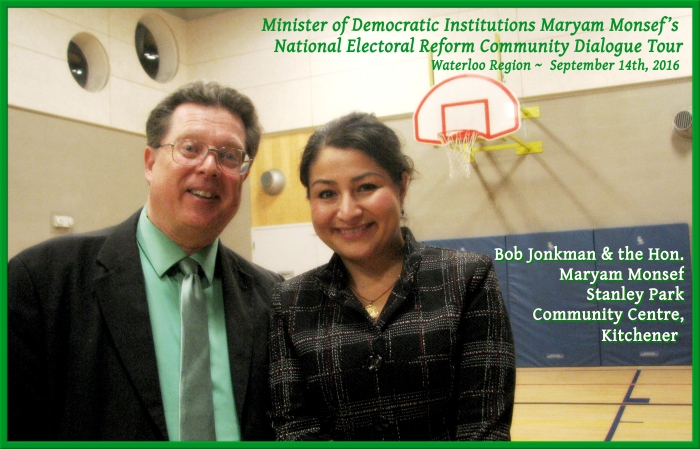
Bob Jonkman & Maryam Monsef
After the consultation, Ms. Monsef was available & approachable