Liberal MPs Marwan Tabbara, Bardish Chagger, Raj Saini, Bryan May and Conservative MP Harold Albrecht Waterloo Region Climate Change Consultation, Kitchener, 2016
When I attended the Kitchener Climate Change Consultation in 2016 it was incredible to see all 5 Waterloo Region MPs in attendance, not just the 4 new Liberal MPs, but my own Conservative MP Harold Albrecht was there too.
Facilitator David Weber
Unsurprisingly 3 of our WRGreen candidates were there helping facilitate the discussions.
I believe our Kitchener Climate Consultation was the biggest one held across Canada. It had more than a full slate of MPs, there were hundreds of engaged citizens there to participate.
There was a lot of great discussion and valuable input as citizens brainstormed ways we could come together and bring Climate Change to heel.
Facilitator Stacey Danckert
It was a heady time. Critical thinking and creativity came together as citizens from across the political spectrum contributed different pieces of the solution to Climate Change, the existential global crisis of our time.
But Waterloo Region was up for it. We were ready.
Each round table discussion yielded up a blueprint of action. And at the end of the day, each table’s facilitators presented a verbal report of the high points to the entire assembly.
Although all 5 Waterloo Region MPs were there, its pretty clear none of them actually listened.
Former Progressive Conservative Party Leader Patrick Brown had had a fully costed moderate election platform complete with carbon tax. But it seems the PC Party backroom boys weren’t ready for a carbon tax, so Mr Brown and his platform were replaced with Mr Ford and a series of off-the-cuff promises masquerading as a platform.
One of the huge costs associated with winner-take-all politics is the policy lurch that happens when a centrist party is replaced by a right wing party. Which is exactly what we’re seeing here in Ontario.
But even before winning the leadership or the election, one thing Doug Ford was *always* clear about was his intention to get rid of the Liberal’s Cap & Trade carbon mitigation system.
CARBON PRICING
With Climate Change breathing down our necks, carbon pricing is intended to disincentivise Green House Gas emissions. It does this by forcing polluters to take financial responsibility for the pollution they generate.
Cap and Trade revenue flowing into Government coffers is supposed to help government finance our necessary transition to a sustainable economy.
While it is clear that carbon pricing is imperative, personally, I am not at all unhappy to see the dismantling of the McGuinty-Wynne Cap and Trade system, although a more orderly change would have been nice.
One big problem with Ontario’s Cap and Trade was that its carbon targets simply weren’t anywhere close to being high enough.
From my perspective, the worst thing about Cap and Trade is that it creates a government revenue stream. Governments get very attached to revenue streams. And the Ontario Liberals had made good use of the Cap and Trade funds that flowed into government coffers.
What do schools have to do with Carbon Pricing?
Ontario schools have been struggling since the 1990’s when the Mike Harris Sr government diverted education tax funds from community school boards into the general government coffers. Now, instead of dispensing all the funds collected for Ontario elementary and high school education through property tax directly to the schools, in the name of “efficiency” education funding was suddenly dependent on a “funding formula” that was more about redistributing education tax than educating our kids.
Government works in mysterious ways… instead of fixing this elementary school, they built a new one.
Suddenly there wasn’t enough money in the Education budget for elementary school music class and librarians. In the rich province of Ontario, school budgets were reduced the bare minimum to function. Chronic underfunding begun by the Mike Harris Sr PC government and carried on by the McGuinty-Wynne Liberals over decades naturally meant there was never enough funding to properly maintain the infrastructure.
But when school buildings began to crumble across the province, the Liberals had to do something: and so some of the Cap and Trade revenue was earmarked to fix our schools. (Although spun in the media as needed repairs, in truth these funds were supposed to be used to retrofit schools to make them more energy efficient.) Sadly even that is gone now, and the folks at http://fixourschools.ca/ will tell you that Ontario schools still need a whole lot of fixing.
Federal Backstop Carbon Pricing
Canadians for Carbon Dividends Ontario Chart
But Ontario’s carbon pricing void will presently be filled with a different kind of carbon pricing, as the Federal Government implements a Carbon Fee and Dividend regime.
This is the carbon pricing policy advocated by both federal and Provincial Green Parties in Canada because it is a much more equitable system.
The fees collected from industry polluters don’t go to line government coffers, but are instead payed out directly to citizens to help us weather the transition.
The dividends counter the price increases industry will pass on to consumers. The way it works out is that consumers with the smallest carbon footprint actually come out ahead.
Even so, it still is not enough.
The IPCC Intergovernmental Panel on Climate Change has made it clear that we aren’t doing nearly enough to address Climate Change. They’ve given us a timeline of 12 years, and time is running out.
While we need to get the new federal Carbon Pricing system up and running, it is only the start.
So it is a very good thing Ontario’s Doug Ford PC Government has stepped up and is conducting its own
Consultation: A made-in-Ontario climate change plan
We never know if our winner-take-all governments will listen, but when they ask us for input on important issues, it is well worth responding. Even if they ignore what we have to say, at least we will be on the record. And the record will be there for the next government.
It is very important for us to respond, to make sure our new PC Government understands Ontario expects serious climate change policy.
This consultation tells us they want our opinions, but they don’t want our names. The only way to participate is to do so anonymously on a web form.
Tips
Your submission does not need to be a scholarly work; you can write as much or as little as you’re comfortable with. When filling in any kind of web form, it’s easiest to prepare your answer offline. That way you won’t accidentally send it before you’re finished, and you can keep a copy of the submission you wrote. It is always an excellent idea to make as much noise as we can publicly online. If you have a blog, share it there and/or sharing on twitter or Facebook or whatever other social media you use. Sharing online can inspire others to participate, and the greater the response the consultation gets, the better. If you don’t have a place to share online, feel free to share your submission with us, and we’ll publish it here on the blog.
Our quality of life depends on clean air to breathe, safe water to drink, and well-protected lands and parks.
Later this fall, Ontario will release a plan that will identify specific areas of focus to help us tackle and be more resilient to climate change.
This will be the first part of a broader approach that will protect clean air and water, encourage conservation and do more to address urban litter and waste.
This made-in-Ontario solution will strike the right balance between protecting our environment and responsibly supporting a prosperous economy.
Areas of focus
The plan will include several areas of focus, such as:
Creating an understanding of the effects that climate change is having on our households, businesses, communities and public infrastructure to better prepare and strengthen our resiliency.
Ensuring polluters are held accountable and creating dedicated measures that will efficiently reduce greenhouse gas emissions.
Improving Ontario’s business climate by unlocking the power of the private sector to finance and drive innovative climate solutions. This will include an emissions-reduction fund to invest in technology-based and other solutions to reduce emissions in Ontario.
Finding a balanced solution that puts people first, makes life more affordable for families, and takes Ontario’s role in fighting climate change seriously.
These areas will help ensure our investments in climate action effectively balance greenhouse gas reductions while supporting economic prosperity and Ontario families.
Brainstorming participants at the Federal Climate Consultation
If you’re not exactly sure what you want to tell the Ontario government’s Climate Consultation, resources follow. (We will update this page with any additional submissions people share with us.
DEMAND the Ontario Government keeps the independent Environmental watchdog, Ontario Environmental Commissioner Dianne Saxe, who has just released “her 2018 Environmental Protection Report, Back to Basics, to the Ontario Legislature.
Delivered as four individual volumes, the report calls on the provincial government to limit water pollution, commit funding towards programs that protect municipal drinking water sources, as well as increase the protection of wetlands, woodlands, and wildlife across the province.
“The environmental commissioner has a mandate to monitor the government’s compliance with provincial environmental laws, including Ontario’s Environmental Bill of Rights, and to report annually on the government’s progress toward its greenhouse gas reduction targets. The current commissioner is Dianne Saxe, a former environmental lawyer, appointed in 2015.”
— CBC Ontario Finance Minister Vic Fedeli delivers the fall economic statement
Ontario needs the independent office of Ontario Environmental Commissioner for our own protection.
Rise For Climate Waterloo Region submission
I offer the following balanced solution to hold polluters accountable to ensure that GHG are reduced and to unlock the power of Ontario’s businesses to finance and drive innovative climate solutions.
Polluters are held accountable by putting a price on carbon pollution. In order to protect Ontarian families from the associated price increase, monies collected from the pollution price can be returned to citizens on a per-capita basis, through a dividend or “climate action incentive”. Canadians for Clean Prosperity has shown that 80% of Ontario’s households will actually get more in climate action incentives than they pay in carbon pollution fees. By having the Ontario Government cancel cap-and-trade, it has opened the door to a transparent price on carbon pollution, with climate action incentives to protect Ontario’s families from price increases.
Rather than entering a expensive court battle over putting a price on carbon (which increases both Federal and Provincial expenditures and therefore, taxes), the Ontario government could drop the lawsuit. Experts indicate that the Federal government will win the lawsuit, as it is critical for Canadian governments to take action on climate change.
In order for the price on carbon pollution to work effectively to reduce emissions, the price needs to be substantially higher than the $50 per tonne that it is scheduled to reach in 2022. Ontario should work with the Federal government to ramp-up of the price for the five years after 2022 to reach the emission reductions needed to meet Canada’s fair-share contribution to our international commitments under the United Nations Conference of the Parties.
As the carbon price increases, it impacts behaviour. In the short term, it will reduce consumption of carbon-intensive energy. In the medium term, it will affect purchasing decisions, as people will want to make purchases that create less carbon pollution. Over the long term, businesses will innovate and offer customers more choice and newer products to help them avoid creating and paying for carbon pollution.
To help Ontarians to assist in this transition, we call on the Provincial government to partner with Municipalities to implement a broad-based education program to educate regarding the causes, effects, and solutions on climate change. This will not only create the political will for bold changes that are necessary, but it will also prepare and strengthen our collective resiliency.
The Green Party of Ontario has an excellent plan of #ClimateAction (you’re not really surprised at this, are you?)
Science-based commitments: Ontario should do its part to limit global average temperature increase to no more than 2C above pre-industrial levels, aiming for 1.5C
Legislated emission targets: Ontario should adopt binding emission targets that respect our share of Canada’s obligations under the Paris Climate Agreement.
15% reduction below 1990 levels by 2020
37% reduction below 1990 levels by 2030
Net Carbon Neutral by 2050
Pollution pricing: Ontario should accept the global consensus from academics, economists, and Nobel Prize winning experts who agree that a price on pollution is the most effective and efficient way to reduce emissions. It is the foundation upon which a credible climate plan is built.
Job creation in the clean economy: Ontario should leap into the $26 trillion global clean economy, supporting jobs and investment in the fastest growing sectors in the world.
Energy efficiency and conservation: Ontario should prioritize energy efficiency and conservation as the first-step solutions for lowering our carbon footprint, while helping people and businesses to save money by saving energy.
More low carbon public transit: electric buses, trains, bike lanes, and
reduce the amount of car infrastructure, ie: parking lots, highway extensions.
Replace gas stations with charging stations.
Subsidize retrofits for all carbon emitting housing and
making it obligatory for all new buildings to be carbon neutral or even carbon negative.
AFFORDABLE HOUSING! Dense spaces along public transit lines. Infill housing, because we want to leave as much nature for nature as possible. DENSITY IS KEY!
Agricultural reform, commiting our greenbelt to 100% agroecological farming practicing and reducing the need for nitrogen fertilizer
mandate all government buildings and operations go zero carbon
Broad-based education for everyone on climate change, impacts, and what we need to do to limit it and adapt to it.
MASSIVE TREE PLANTING INITATIVE!
Also remind Mr Ford that he famously said the best way out of poverty is “something called a job.” All of the above (again not exhaustive) will lead to a huge number of jobs.
Often when we talk about Climate Action the topic is about how to slow or stop Greenhouse Gas Emissions. But part of the problem is that we already have a ridiculous amount of carbon in our atmosphere now that needs to be dealt with. The comprehensive book “Drawdown” looks at a whole host of strategies — 100, in fact — for fighting climate change across the board. You’ll find even more ideas to include in your consultation submission on the Drawdown website’s solutions page
Suggestions from the Waterloo Region Federal Climate Change Consultation:
This is not a Green Party event, but since Sustainability and Ecological Wisdom are core values for all Green Parties everyone is encouraged to attend
The Nith Valley Ecoboosters are pleased to present an informative and timely talk featuring Dr. Blair Feltmate. Dr. Feltmate is Head of the Intact Centre on Climate Adaptation at the University of Waterloo. He has written textbooks on environmental science and sustainable development and is involved in the creation of several national climate adaptation Standards involving the National Research Council, Standards Council of Canada and the Canadian Standards Association. Blair is also Chair of the Federal Government of Canada Expert Panel on Climate Adaptation.
Significant damage from high winds, heavy rain and floods is becoming a more frequent occurrence. Members of our community need to know how to protect themselves and their property so that the effects of severe weather can be minimized. Dr. Feltmate will begin his presentation by establishing that climate change is real, and is causing extreme weather events – particularly in the form of flooding. This “new normal” situation has proven to be costly for all regions of Canada. In an effort to help limit future losses, the discussion will then address practical and cost-effective steps that home owners and communities can take to lower their flood risk profile. Dr. Feltmate will be happy to take questions from the audience throughout his presentation.
Doors open at 7:00PM and the presentation will begin at 7:30PM. Light refreshments will be served at approximately 8:45PM.
This event is sponsored by:
The Nith Valley Ecoboosters
The Imperial (New Hamburg)
Intact Insurance (London)
John Zehr Insurance (New Hamburg)
Zion United Church (New Hamburg)
Grant Holdings/Grant Jutzi (New Hamburg)
Nith Valley Construction (New Hamburg)
Kindred Credit Union (New Hamburg)
Town Pantry Health Food Store (New Hamburg)
The Baden Outlook
Jonathan Barker Illustration (New Hamburg)
What: Warmer, Wetter and Wilder with Dr. Blair Feltman When: Tuesday, 6 November 2018 from 7:30pm to 9:30pm Where: Zion United Church Location: 215 Peel Street, New Hamburg, Ontario Map
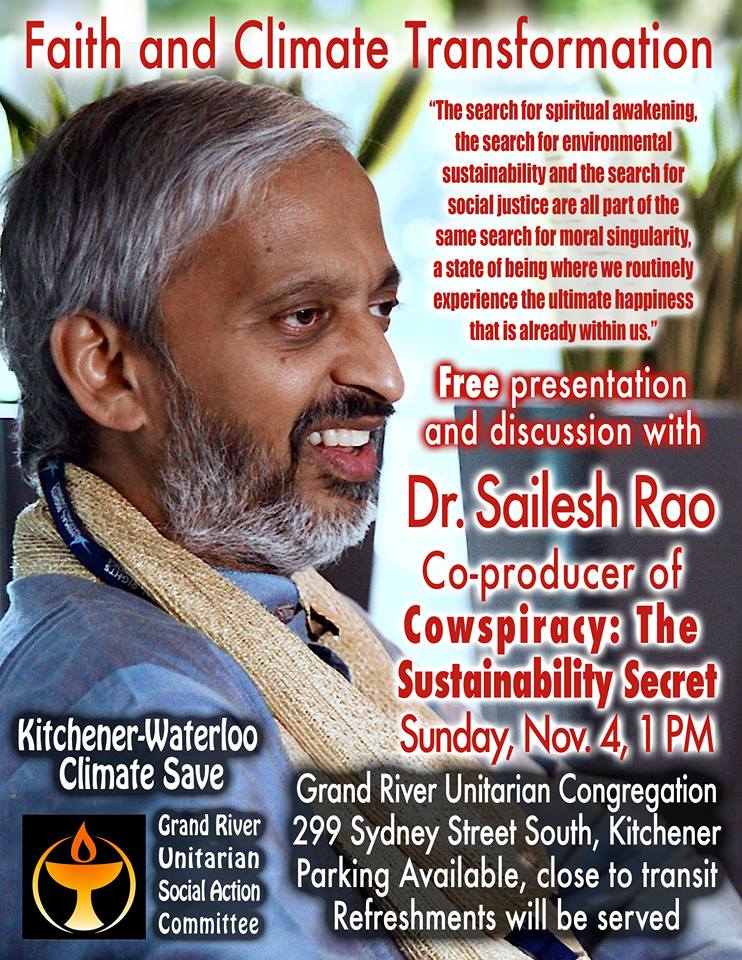
He has presented at all the major Climate summits, including the Paris Accord and once worked with Al Gore. Being frustrated that no one was talking about the REAL causes of climate change he co-produced three films, including Cowspiracy and What the Health.
You can get more information from his website: Climate Healers
The search for spiritual awakening, the search for environmental sustainability and the search for social justice are all part of the same search for moral singularity, a state of being where we routinely experience the ultimate happiness that is already within us.
Free presentation and discussion with Dr. Sailesh Rao
Co-producer of Cowspiracy: The sustainability Secret
Sunday, November 4, 2018, 1:00pm
Grand River Unitarian Congregation Map
299 Sydney Street South, Kitchener
Parking available, close to transit
Refreshments will be served.
Back in 2015, 122 Ontario doctors pressed then Ontario Liberal Minister of Health Eric Hoskins to adopt Basic Income because income (or lack thereof) is a serious health issue. The Wynne Government took its sweet time about it, and I have no doubt at all their Basic Income Pilot was intended to result in re-election. Still, WRGreens own Stacey Danckert pointed out the last Liberal Budget provided no funding to do anything after the pilot would have ended.
During our recent provincial election campaign, the Liberal, NDP, Green, and Doug Ford’s PC Party all indicated they they would continue the Ontario Basic Income Pilot after the election.
Universal Basic Income
The idea of Universal Basic Income is actually an old one, dating back to the Fourteen Hundreds. Far from being a left wing, socialist or communist idea, the concept spans the political spectrum, no doubt in part because poverty does too. There are left (human dignity) and right (stop theft) arguments for such a system, particularly in capitalist nations like Canada that are already investing vast sums in a piecemeal social safety net that has not managed to make a dent in citizen poverty. In Canada politicians of every political stripe have agreed we need to eliminate child poverty, and yet poverty is still with us.
Even American Nobel Prize winning economist Milton Friedman advocated for a basic income alleviation of poverty.
"Suppose one accepts, as I do, this line of reasoning as justifying
governmental action to alleviate poverty; to set, as it were, a floor under the
standard of life of every person in the community."
In his role of economic adviser to Republican President Richard Nixon, Friedman supported a negative income tax as a means of creating that floor and eliminating poverty. Had Nixon’s government not fallen in scandal, such a regime may have even been implemented in the US.
The international resurgence of interest in the idea of a Universal Basic Income gathering steam in the early 21st Century is growing fast for a host of reasons, including the collapse of manufacturing due to so called “free trade” agreements combined with the rapidly approaching decimation of the job market by ever increasing loss of human jobs through automation.
All of this is why it was reasonable to take Premier Ford’s promise to continue the OLP’s Basic Income Pilot Project if his party came to power. Whether for or against the idea, it only makes sense for any government to complete a project that has already cost the taxpayers of Ontario so much to get the data at the end of the rainbow. Any decision to take the matter further or toss it out could then be made based on facts rather than partisan rhetoric.
Sadly it seems Mr Ford prefers rhetoric. Rather than forging sound public policy in order to govern “for the people,” his new Government has opted to cancel Ontario’s Basic Income Pilot.
More than 20,000 people have signed this change.org petition asking the Ford Government to Save the Ontario Basic Income Pilot Project. But the Ford Government isn’t listening to the people.
But all doesn’t need to be lost.
The Hamilton Roundtable for Poverty Reduction has appealed to the federal Liberal Government:
The Liberal Party of Canada has a long history with Basic Income, and in fact it was Prime Minister Pierre Trudeau’s Government that co-authored the 5 year Mincome Pilot in Dauphin Manitoba in the 1970’s. Unfortunately, as often happens with long term projects under short sighted FPTP voting, Mr Trudeau’s Government fell and the data from the just completed pilot project was shelved and buried, only emerging for consideration many decades later.
We believe there is tremendous national value in finishing this project. Every province is grappling with how to provide a strong social safety net that allows people to lead dignified lives without creating excessive administration. We are in desperate need of preventative approaches that will reduce the burden of poverty on our health care, education, and criminal justice systems.
Instead of starting their own Basic Income project from scratch, the Justin Trudeau Liberal Government need only spend $50 million dollars to complete the Ontario Basic Income Pilot project. That would be an incredible bargain basement price for data that would prove invaluable for making federal economic policy.
What can we do to help?
We can write our own letters to the Prime Minister and our own MP (and remember– physical letters travel postage free to the federal government.) But we can also sign every petition… like the one just begun by our friends at The Council of Canadians:
Join the groups and organizations that make up KWPeace for a midday meal and a conversation about Peace, Nonviolence, Social Justice and Climate Change.
Tamara Lorincz The guest speaker is Tamara Lorincz, who is completing her PhD studies in Global Governance at the Balsillie School of International Affairs. She will talk about Canada’s new defence and foreign policies and the environmental and social impacts such as climate, military spending, etc. The food for this event is provided by Kitchener Food Not Bombs, which picks up donated food from grocery stores, cooks fresh vegan meals, and serves these meals to the community for free! All groups and organizations working towards Peace, Nonviolence, Social Justice or Climate Change are invited to have an information table around the rotunda. Please register to reserve your place.
There is no charge for this event, but donations are gratefully accepted to offset the costs.
What: Perspectives On Peace — Where’s The Peace and Justice? Canada’s New Foreign and Defence Policies When: Saturday, 27 October 2018 from noon to 2:00pm Where: The Rotunda, Kitchener City Hall Location: 200 King Street West, Kitchener, Ontario Map
Cities and regions around the globe are taking the myriad threats of climate change VERY seriously, and many are taking active steps to ‘future proof’ their communities. We are already seeing the impacts in our own backyards – and we know that decisions will need to be made today to address tomorrow’s looming climate dangers. On behalf of Region residents and voters concerned with the devastating impacts of climate change felt right here in the Region of Waterloo and across our warming planet, we asked candidates seeking office in the Region of Waterloo to review and reply to a survey questions.
The answers from all 4 candidates seeking Regional Chair position are posted HERE.
The Intergovernmental Panel on Climate Change released a special report today on the impacts of global warming of 1.5℃ above pre-industrial levels.
The report outlines the considerable challenges of meeting the Paris Agreement’s more ambitious goal of limiting warming to 1.5℃, the global effort needed to achieve the target, and the consequences of not.
Correction: A previous version of this article stated that the Australian Labor Party had a goal of reaching 50% renewable energy by 2050. But the ALP hope to achieve the 50% target via an emissions intensity scheme by 2030.
Hi WR Greens: Did you know that voters in Cambridge have a referendum question on Ranked Ballots this municipal election:
Are you in favour of the City of Cambridge using a ranked ballot voting system for the 2022 municipal election?
The Yes! Cambridge advocacy group is holding an informational Town Hall Meeting on Thursday, 11 October 2018 at 7:00pm for anyone who wants to know more about how Ranked Ballots could work, and what the effects might be on campaigns and elections.
Note that this is not a Green Party event, but since electoral reform is a fundamental Green Party policy I expect it’s of interest, especially for those people living and voting in Cambridge.
What: Yes! Cambridge Town Hall Meeting on Ranked Ballots When: Thursday, 11 October 2018 from 7:00pm to 8:30pm Where: Wesley United Church Location: 6 Cambridge Street, Cambridge, Ontario Map


 Even so, it still is not enough.


 The Nith Valley Ecoboosters are pleased to present an informative and timely talk featuring Dr. Blair Feltmate. Dr. Feltmate is Head of the Intact Centre on Climate Adaptation at the University of Waterloo. He has written textbooks on environmental science and sustainable development and is involved in the creation of several national climate adaptation Standards involving the National Research Council, Standards Council of Canada and the Canadian Standards Association. Blair is also Chair of the Federal Government of Canada Expert Panel on Climate Adaptation.
 Kitchener-Waterloo Climate Save
 Grand River Unitarian Social Action Committee

 Download the poster (.PDF, 2 MBytes)


 CC BY-ND
 Yes! Cambridge
 wrgreens