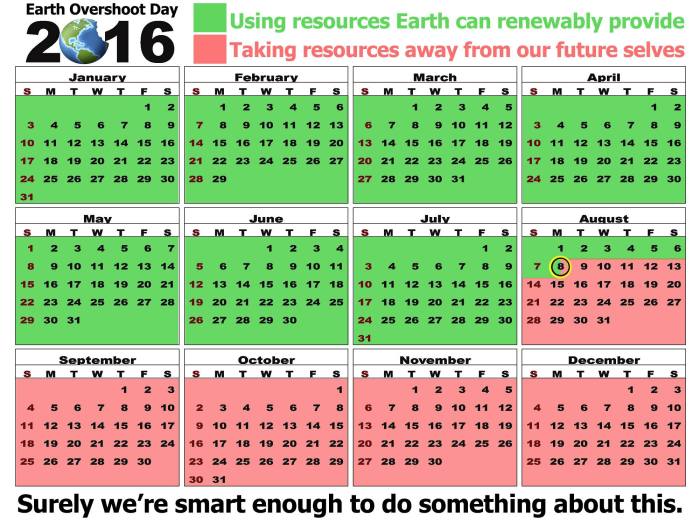
Today is Earth Overshoot day, which means that today humanity has used up the amount of resources that the planet can reliably provide us renewably for the entire year. It moves several days earlier each year; in 2015 it happened on August 13th. The official website makes a number of suggestions for ways that you can make a difference.
The idea that we can continue to demand ever more each year from a planet that isn’t getting any bigger is more than a little nuts, so maybe it’s time to stop taking the word of economists about it.
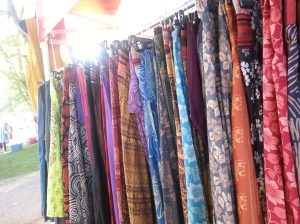
Wednesday, 6 July 2016 from 6 PM – 8 PM Trusted Clothes is hosting a clothing swap at 283 Duke Street West, Kitchener, Ontario Click here for a Map
Bring good quality clothes that you don’t want anymore and leave with the same amount of new stuff!
Event is completely free and is to raise awareness about textile waste and the environment.
Men’s, women’s, kid’s, baby’s, accessories and shoes – all are welcome.
We have partnered with the Kidney Foundation to collect any leftover clothes with proceeds going to research. Please feel free to bring any clothing you wish to donate as well.
— Trusted Clothes facebook event page
Although this is not a Green Party event, Trusted Clothes commitment to ethical, sustainable environmentally friendly (and health conscious!) endeavours will very likely appeal to green folk.
When we talk about climate action in Canada, the conversation often turns to fossil fuel subsidies — the billions of dollars our Federal and Provinical governments, as well as Export Development Canada, have been spending to support our oil & gas sector. The 2015 Paris climate agreement, signed last fall by the current Federal government, gives new urgency to keep global temperature rise below two degrees. To do that, we need to keep fossil fuels in the ground.
Fort McMurray. (Photo courtesy Flickr user sbamueller)
This week, the “Three Amigos” summit saw Canada, the U.S., and Mexico agree to common goals for transitioning to a low-carbon, clean energy future. Like the Paris agreement, it’s a generally positive committment that needs to be followed up — soon — with action.
The “North American Climate, Clean Energy, and Environment Partnership”, as it’s called, re-affirms Canada’s 2009 committment to phase out fossil fuel subsidies in the “medium term”. This week’s news sets a more specific goal — Canada, the U.S., and Mexico have agreed to a phase-out date of 2025.
So let’s get going. If Canada is serious about transitioning away from fossil fuels, we need to do much more than the Liberal election platform proposes (a modest scaling-down of one particular tax deduction). We still have a complex web of subsidies that benefit the oil & gas sector. They all need to go.
Deductible expenses
Tax deductions let corporations declare expenses to reduce their taxable income. These four programs directly encourage the expansion of fossil fuel operations at home and abroad:
10% deduction for Canadian Oil and Gas Property Expenses (e.g. buying oil sands rights, buying a well, leases, permits, and licenses)
30% deduction for Canadian Development Expenses (e.g. expanding a mine, building new haulage routes)
30% deduction for Foreign Resource Expenses (e.g. overseas exploration and drilling of fossil fuels)
100% deduction for Canadian Exploration Expenses (e.g. surveying land for new fossil fuel extraction opportunities, environmental studies, and community consultations before opening a mine)
Provincially, B.C. also offers a 20% tax break on coal mining expenses through the Mining Exploration Tax Credit.
Accelerated Capital Cost Allowance
Capital Cost Allowance (CCA) is a way for all kinds of businesses to deduct the cost of equipment over several years.
Accelerated Capital Cost Allowance (ACCA) speeds that process up, putting money back into the hands of fossil-fuel companies faster and reducing their taxes.
While the ACCA no longer applies for oil sands projects, it was recently introduced for liquified natural gas (LNG) projects.
In 2014, Canada eliminated duty fees for offshore oil and gas drilling equipment. This makes it more affordable for Canadian companies to drill for fossil fuels in our vulnerable Atlantic and Arctic waters.
Flow-through share deductions
Normally, tax deductions can only be claimed by the business that actually incurs the eligible expense. However, flow-through shares let corporations pass on the deductions directly to investors, whose income gets taxed as capital gains, at half the rate of regular income.
Canada allows flow-through shares for qualifying Canadian Development Expenses and Canadian Exploration Expenses – a sweet kickback for both corporations and their individual investors.
Royalty credits
In Canada, natural resources such as minerals, oil, gas, and groundwater are owned by the Provinces. They charge royalties to companies that extract these resources.
B.C. offers a Deep Drilling Credit that waives royalty fees between $444,000 and $2.81 million per well for new fossil-fuel drilling projects.
B.C. also offers up to 50% discount on royalites for oil & gas companies to build new roads and pipelines through the Infrastructure Royalty Credit Program. The purpose of the program is to boost oil & gas exploration, and extend the drilling season year-round.
Reduced sales tax
Both Manitoba and B.C. don’t charge provincial sales tax on machienry and equipment involved in oil, gas, and mining. This includes prototyping equipment, surveying and exploration equipment, and even drill bits. There’s also a discount on the electricity required to operate the machinery.
Where do we go from here?
This week’s “Three Amigos” agreement needs to be followed up with aggressive action.
If we are to keep the planet from spilling over that 2-degree threshold, we can’t continue funding dirty fuels.
If we’re going to encourage clean energy development, we can’t keep incentivizing oil & gas exploration.
As we move forward, remember that there is a lot of work to be undone. It starts with dismantling these subsidies.
Today (Friday 13 May, 2016) is the last day the public can weigh in on this awful open pit mine project.
Canada’s First Nations peoples have always stood up in defense of the land; it is important that all Canadians do our part. I’ve just got the information, which I dressed up into this very long submission. If I wasn’t sharing this with you here, I would probably have picked one or two things and made a much shorter submission, but since I’m sharing this here I decided to load up the whole works. Submissions don’t have to be long and complicated; feel free to make use of this.
sissonproject@ceaa-acee.gc.ca
Catherine.McKenna@parl.gc.ca
Subject: Sisson Mine Project, Registry # 63169
To: The Canadian Environmental Assessment Agency and The Honourable Catherine McKenna
I am pleased to raise my voice in support the Maliseet First Nations who rightly oppose the proposed open-pit mine because of the terrible impact it will have on them and the environment. As big as Canada is, we simply can not afford the risk of environmental contamination we know will result from the Sisson open pit mine.
Since the Canadian government has finally endorsed the United Nations Declaration on the Rights of Indigenous Peoples it is unthinkable that a project that will so dramaticaly interfere with Maliseet First Nations people’s right to traditional use of crown land would even be considered.
Please heed the serious concerns of the Canadian citizens of the Maliseet First Nations. Don’t put the commercial interests of a private mining corporation ahead of the well being of Canadians and our environment. Government should seek to protect public health and safety, to ensure that the lives o citizens are not negatively impacted and/or endangered by a project like this open pit mine so fraught with risk. More and more people around the world are realizing that jobs aren’t any good if you can’t breathe the air or drink the water or grow food it is safe to eat.
The Sisson open-pit mine project is predicted to result in the loss of land (approximately 1,253 hectares), and residual impacts on resources used by Maliseet and Mi’gmag First Nations for traditional purposes.
The possibility of even a handful of the potential risks identified in the CEAA’s own report on the Sisson mine should be enough to halt this project.
The Canadian Environmental Assessment Agency (CEAA) report on the open pit mine reveals:
negative effects on the atmospheric environment from emissions such as dust, odour, noise and vibration;
water quality degradation as a result of seepage (beween 130 and 170 litres per second!) from the tailings storage facility and release of water from the water treatment plant (i.e. increased concentrations of trace metals);
changes in water quantity and flow regimes as a result of water retention and discharges;
effects on fish and fish habitat including the direct and indirect loss of habitat;
fish would be lost,
effects on wildlife, including species at risk, from ingestion of contaminants, sensory disturbance, and habitat loss;
direct loss (destruction) and changes in the function of wetlands, including removal and alteration of habitat supporting avian species at risk;
people intermittently using the project area for hunting, fishing, trapping, and other activities may be exposed to elevated levels of contaminants in the atmosphere, drinking water, or in harvested foods
effects on human health from consumption of country food and water impacted by project emissions and discharges;
the tailings pond would seep into the surrounding environment,
water contaminated through mine contact and processing on the site would be discharged downstream,
that waste rock would generate acids,
local fresh-water resources would be used in the various processes on the site,
negative effects on the current use of lands and resources for traditional purposes by Aboriginal persons including hunting and fishing,
negative effects on archaeological resources; and
and that hazardous materials would be stored there to the extent that Emergency Response Plans would be required.
The CEAA concludes the Project is likely to result in significant adverse environmental effects on the current use of lands and resources for traditional purposes by Maliseet First Nations. Only a limited number of large contiguous Crown land blocks, particularly along the Saint John River valley, remain available to practice current uses for traditional purposes proximal to the Maliseet communities of Tobique, Kingsclear, Woodstock, and St. Mary’s First Nations. Within the remaining Crown land blocks, use by these First Nations is limited by other existing land uses. Given this context, the Agency concludes that the environmental effects of the Project, in combination with the cumulative environmental effects of other projects and activities, on the current use of lands and resources by Maliseet First Nations are also likely to be significant.
Health Canada, Maliseet First Nation and Mi’gmag First Nation have all asked for more samples to be collected showing pre-existing “baseline concentrations of potential contaminants in fish, wildlife, and vegetation.” The Ministry of Environment and Climate Change Canada asked “the proponent to commit to follow-up studies of metal concentrations in wildlife species important to resource users and First Nations.”
And yet, according to the CEAA report, the proponent stated that “no further monitoring was warranted.”
The mining company’s consultants neglected to include arsenic in the non-carcinogenic risk evaluation, even though they admit arsenic concentrations may increase in local surface waters.
There is also no known solution to the risk of increased boron concentrations in fish tissue. We know evaluating trace metal impacts on human health after it occurs is not in keeping with the precautionary principle of avoidance, rather than insufficient mitigation and post-tragedy studies.
That the mine consultants “predicted a total tailings storage facility seepage rate between 130 and 170 litres per second and losses from the seepage collections system to groundwater between ten and 30 litres per second during operations” it is clear harmful water will not be under control on site
There are a lack of air quality monitoring commitments from the mine
In light of all of these things, it is grossly irresponsible to burden citizens with the responsibility of proving harmful water impacts have been caused by the mining company before investigation and mitigation by the proponent would occur.
The wishes of the First Nations communities opposing the Sisson mine must be respected; this project must not be given approval.
Impeccably researched, After the Sands is critical reading for anyone concerned about rising sea levels, pipeline and tanker spills, climate change chaos and Canada’s future in a carbon restricted world.
Ralph Nader hails it as “a myth-destroying blockbuster book.”
The talk will be followed by responses from the community to relate Laxer’s work to local struggles and opportunities.
Where: Kitchener Public Library, Central Library Theatre, 85 Queen Street North, downtown Kitchener [Map]
When: Wednesday, April 6th, 7:00–8:30pm (note that community groups will have information tables outside the theatre starting at 6:30)
The event is free and open to the public—everyone is welcome!
This event is hosted by the Department of Political Science with support from numerous campus and community groups including the Kitchener Public Library, the Waterloo Aboriginal Education Centre, the School of Environment, Resources and Sustainability, the Balsillie School of International Affairs, Sustainable Campus Initiative, Waterloo Political Economy Group (WatPEG), Waterloo Public Interest Research Group (WPIRG),ClimateActionWR, the Council of Canadians (Guelph and Centre Wellington Chapters), Divest Waterloo, and KAIROS. Wordsworth Books and Hacienda Coffee folks will be on hand with books for sale and treats to share!
 Today is Earth Overshoot day, which means that today humanity has used up the amount of resources that the planet can reliably provide us renewably for the entire year. It moves several days earlier each year; in 2015 it happened on August 13th. The official website makes a number of suggestions for ways that you can make a difference.
 Wednesday, 6 July 2016 from 6 PM – 8 PM


 wrgreens