based on the book edited by Michael Chong, Scott Simms, and Kennedy Stewart
Practical Ideas for Reforming Canada’s Democracy
featuring
Michael Chong on Parliamentary Reform
Elizabeth May on Electoral Reform
Tuesday, October 10, 2017 7:00pm to 9:00pm
Harcourt United Church, 87 Dean Avenue, Guelph Map
Liberal and NDP representatives from the local riding associations have been invited to reflect on the main presentations
This event is free and accessible (through the back door to the church around the corner from the parking lot). All welcome. Audience participation encouraged. Donations accepted.
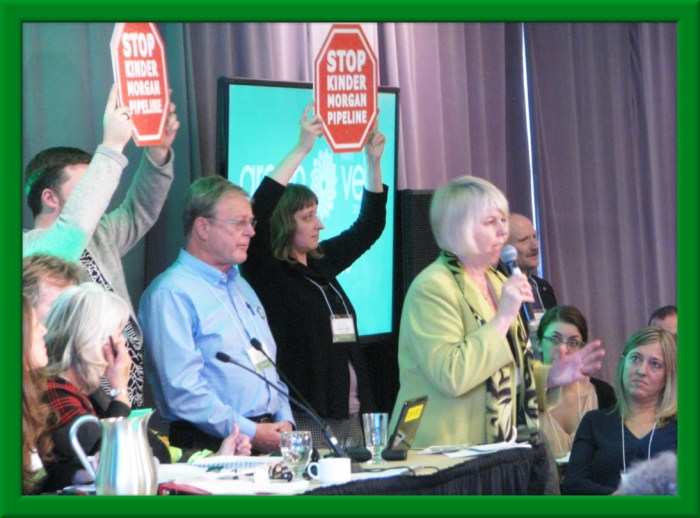
As most readers will be aware, the Green Party of Canada just conducted a Special General Meeting in Calgary to deal with some urgent business, namely human rights, pipelines and electoral reform.
Green Parties around the world share common values as expressed in the Charter of the Global Greens. The policies of the Green Party of Canada are based on six fundamental principles
We recognize the scope for the material expansion of society within the biosphere, and the need to maintain biodiversity through the use of renewable resources.
We assert that the key to social justice is the equitable distribution of resources to ensure that all have full opportunities for personal and social development.
We strive for a democracy in which all citizens have the right to express their views, and are able to directly participate in decisions which affect their lives.
We honour and value equally the Earth’s biological and ecological diversity together with the context of individual responsibility toward all beings.
In Calgary this past week the Green Party of Canada took a principled stand for human rights, demonstrating our respect for people in Canada and around the world.
S16-P013 Measures to pressure the government of Israel to preserve the two-state solution: addendum to current Middle East policy
Canada’s friendship with Israel does not mean we should avert our eyes from the human rights abuses Israel continues to visit upon its captive indigenous population. The Occupied Palestinian Territory (OPT) has been under martial law for decades. The Government of Israel’s continuing policy of appropriating land for settlements from what little land is left in Palestinian hands has been deplored around the world, not only because it is an egregious violation of International Law, but, as the United States has pointed out, this active colonialism undermines any hope for peace.
If the Green Party of Canada is to live up to the promise of our core values of non-violence, diversity and social justice, we must hold every country — including and perhaps especially our friends — accountable to International Law. The sad truth is that Canada has failed to do what our government’s own policy says it will.
Thankfully the Green Party has stepped up to the plate, with the adoption of enhanced foreign policy that will give the growing number of Canadians who want peace in the Middle East a voice in Parliament. At the SGM, we revisited the Israel-Palestine policy adopted in August to address perceived problems in the original resolution. At the Calgary SGM, the new Consensus Resolution put forward by the GPC Shadow Cabinet was adopted by 84.35% of the plenary. GPC members who weren’t able to attend can watch the livestream on the Party Website.
You can also listen to Dimiti Lascaris (the original resolution’s mover) being interviewed on Vancouver’s Co-Op Radio. Dimitri explains this past weekend’s adoption of a suite of policies defending the rights of indigenous peoples in Canada and Palestine establishes the Green Party of Canada as the champion of human rights in Canada’s Parliament. (His interview begins at 19:52 of the podcast.)
Canada is not the only member of the International Community to be reconsidering Middle East policy. I found the following quotation from Australian MP Adam Bandt to be particularly apt.
“There is no point in being friends with governments if you do not use that supposed friendship to stand up to them when they do the wrong thing—to say, ‘You need to act on what is clearly an egregious abuse of human rights.’ Otherwise, if you do not stand up to governments when they do that, you become complicit in it. The standard that you walk past is the standard that you accept. That means that the Australian government has now been put on notice. It has taken action in the past, and it is time that it renewed that action so that we address what is clearly an unlawful but also immoral abuse of children.”
— The Honourable Adam Bandt, Australian MP, (Green) Nov. 21, 2016
Truth and Reconciliation
Lorraine Rekmans, GPC Indigenous Affairs Critic

As Canada embarks upon our own road to Truth and Reconciliation, we need to do what we can to promote active solutions. For the GPC that process began with the adoption of this suite of Canadian Indigenous Peoples’ rights policy, including rejection of the odious “Doctrine of Discovery.”
S16-P001 Implement Recommendations from the Royal Commission on Aboriginal Peoples Report, 1996
Policy Resolution Submitted by Lorraine Rekmans
BE IT RESOLVED That the Green Party of Canada urge the Government of Canada implement the recommendations made by the Royal Commission on Aboriginal Peoples.
S16-P002 Rebuilding and Recognition of Original Indigenous Nations
Policy Resolution Submitted by Lorraine Rekmans
BE IT RESOLVED that the Green Party of Canada urge the Government of Canada to implement, support and resource measures to advance Indigenous nation building where Indigenous peoples develop and implement their own strategies for rebuilding Indigenous nations and measures to reclaim Indigenous nationhood, including;
(a) cultural revitalization and healing processes; and,
(b) political processes for building consensus on the basic composition of the Aboriginal nation and their political structures; and,
(c) processes undertaken by individual communities and by groups of communities that may share Indigenous nationhood.
S16-P003 Support Indigenous Women
Policy Resolution Submitted by Lorraine Rekmans
BE IT RESOLVED that the Green Party of Canada urges the Government of Canada to work in partnership with Indigenous women and fund such programs and services that ensure poverty amongst Indigenous women is eliminated.
S16-P004 Repudiation of the Doctrine of Discovery
Policy Resolution Submitted by Lorraine Rekmans
BE IT RESOLVED that the Green Party of Canada renounces and repudiates the Doctrine of Discovery and calls on the Government of Canada to repudiate and renounce the Doctrine of Discovery.
S16-P005 Indigenous Peoples’ Health Care in Canada
Policy Resolution Submitted by Lorraine Rekmans
BE IT RESOLVED that The Green Party calls upon the Government of Canada to engage Indigenous Peoples of Canada in the negotiation and implementation of the next federal/provincial /territorial Health Accord;
BE IT FURTHER RESOLVED that The Green Party calls upon the Government of Canada to establish measurable goals and identify and close gaps in health outcomes for Indigenous people by implementing the recommendations made by the Truth and Reconciliation Commission;
BE IT FURTHER RESOLVED that The Green Party calls upon the Government of Canada to ensure that Health Care services for Aboriginal people in Canada meet or exceed the standards set for all Canadians;
BE IT FURTHER RESOLVED that the Green Party calls on the Government of Canada to provide federal funding to Indigenous healing centres.
Pipelines
Former Green Party Deputy Leader and current Councillor of the City of Vancouver, Adriane Carr submitted an emergency resolution to Green Party SGM regarding the recent ill advised Kinder Morgan decision.
“The motion basically calls on the Green Party of Canada to embark on a robust nationwide campaign to educate the public about accelerating climate change, and the impacts of decision that the Prime Minister and the cabinet just made around Kinder Morgan and the fact that kind of decision really does have a huge impact on our climate.”
— CKNW: Adriane Carr submits emergency resolution to Green Party, seeks reversal of Kinder Morgan decision
Adriane Carr addresses the SGM plenary
The Green Party has been clear about pipelines: the only hope of effective climate change policy starts with keeping it in the ground. In spite of our new Liberal Government’s COP 21 commitment in Paris, Canadians have been seeing a disconnect between words and actions. Instead of the promised NEB reformation, the current government has left the flawed process in place, and insupportable pipelines are being approved same as always.
S16-P020 is the Husky Oil Spill resolution, intended to raise public awareness of the effects of the July 20 2016 oil spill in Saskatchewan, calling on Saskatchewan to review its environmental assessment rules and ensure there are adequate pipeline inspections
Electoral Reform
Peter Bevan-Baker, PEI
Elizabeth gave a report on the Electoral Reform process to the plenary on Saturday (I’m hoping to post video on the WRGreens YouTube channel).
In order to fulfil their mandate, the MPs representing four of the five parties in Parliament and on the ERRE Committee came together to form consensus. This required both Green and NDP Committee members to soften the stance of their respective parties and accept the notion of a referendum. (Incredibly, the Liberals who promised to make every vote count dissented, as the party is now frantically back pedalling on their own promise while the other four parties fight for it.) You can read/download the PDF the full final ERRE Committe report for yourself here.
On Sunday morning there was an Electoral Reform workshop, featuring PEI Green Party Leader Peter Bevan-Baker, who has recently having his own adventures with Electoral Reform. The workshops resulted in three new resolutions that were adopted at the SGM (but still in need of ratification — don’t forget to vote!)
Members of the SGM Electoral Reform workshop decided to amend party policy as follows, with three new resolutions that frame the GPC policy to allow Elizabeth more leeway in Electoral Reform negotiations on our behalf.
S16-D017 Referendum
Be it resolved that the Green Party of Canada’s position regarding referenda on electoral reform is:
That the Green Party of Canada supports conducting a referendum on electoral reform with options of proportional systems with a Gallagher index of 5 or less, as presented by the Special Parliamentary committee on Electoral Reform, but only
1) if the referendum presents only proportional voting options;
or
2) after at least two consecutive elections using a proportional voting system.
To more effectively lobby for meaningful electoral reform at this critical juncture, it was decided the Green Party should explicitly back a single specific form of Proportional Representation. Among other things it will make it easier to explain this important issue the majority of Canadians who are just now learning about PR when we only have one system to explain. Although the GPC has expressed a preference in this resolution, the language of the resolution was careful not to close the door to support of any other suitable Proportional System with a Gallagher Index of 5 or less.
S16-D018 Preferred Voting Model
BE IT RESOLVED that the Green Party of Canada supports mixed member proportional representation as its preferred method for achieving equal and effective votes.
BE IT FURTHER RESOLVED that the Green Party of Canada will remain open to other proportional representation options with a Gallagher index of 5 or less, as presented by the Special Parliamentary committee on Electoral Reform
The third electoral reform resolution empowers the party to keep working hard for electoral reform at this critical juncture.
S16-D019 GPC Task Force
BE IT RESOLVED that the Green Party of Canada create a task force that will liaise and work with the Party Leader and the Shadow Cabinet to focus on promoting electoral reform within Canada.
BE IT FURTHER RESOLVED that the Green Party of Canada will direct resources and funding toward educating the public on the GPC’s electoral reform priorities
Whose Democracy Is It?
The Liberal Government has sent postcards to every Canadian household (at great expense), completely ignoring the work of its own ERRE Process in which Canadians are asked to complete a deeply problematic survey which requires participants to sacrifice an unreasonable amount of personal privacy in order to have our input included. The Government’s own website gives a little background, and then redirects us to the corporate website of the marketing firm we are expected to share such personal information as our household income. This is supposed to be okay, because we are not required to tell them our name. Except the personally identifiable information we are required to share is sufficient for Vox Pop Labs to ensure the answers made by multiple people completing the survey at the same address are distinct individuals (indicating the personal data we are required to surrender is far more invasive than simply giving our names would be.
Postcards
At the GPC SGM there was talk of Operation Postcard parties throughout the festive season, and to make the process easier, Bonnie North was instrumental in helping develop the tools to make participation easier.
Fair Vote Canada had also set up a website intended to help Canadians navigate the convoluted survey at mycanadiandemocracy.ca/
The negatives attached to the mydemocracy.ca online survey make it difficult to recommend that Canadians engage in the Government’s dubious exercise, particularly in light of concern the aim of the survey is to provide justification to back away from meaningful reform.
Which is why I was ecstatic to discover there are other ingenious ways to send an emphatic message. I was particularly taken with this clever idea of what we can do with our government postcards:
There are many variations on this theme, some of which can be found under the Twitter #OperationPostcard hashtag. But since only a single postcard is being sent to each Canadian household, those of in homes with more than one citizen are limited to a single opportunity to express a preference with the postcard. But fear not! If there are more people in your household who would like to offer an opinion, or even if you haven’t received your postcard yet in the mail, the Green Party provides an opportunity to print your own copy of the postcard at home here.
The Real Questions
Because the government survey fails on so many levels, the Green Party has put together its own straight forward survey to allow Canadians to answer The Real Questions. It’s packaged in an online tool so we can send to our own responses ~ along with am optional personalized message ~ direct to Maryam Monsef, The Minister of Democratic Institutions and Prime Minister Justin Trudeau. I sincerely hope every Canadian takes this opportunity to make our preferences known to the government. You don’t even have to be a GPC member or even a supporter to fill this survey out… it’s being offered as a public service.
The most fun to come out of the electoral reform workshop was this parody song, “All I Want For Chrisrtmas Is PR,” performed here by the GPC SGM Plenary.
Ratification
In the past, all Green Party Policy resolutions passed at Convention were ratified by the entire membership in an online vote. SGM 2016 has restored this practice, and so all GPC members should be in receipt of email instructions on how to vote to ratify the resolutions. All GPC members across Canada should have received an email on December 7th, 2017 which contains information and our voting credentials.
If you haven’t received your, please contact the GPC immediately. Don’t forget to vote!
The above links only work if you sign into the GPC website (they’re in the secure members area). I’ve included them as I found it helpful to be able to refer to the texts to know what I was voting on. There didn’t seem to be a way to do that from within the voting app.
“I am very happy that all the motions being sent out for ratification were the products of a consensus-seeking process. Many were unanimous. Those that moved to a vote were passed overwhelmingly. I support all of them.”
— Elizabeth May, “What happened in our Calgary meeting”
All GPC members can (and should) participate in the ratification vote. You can vote until February 6th, 2017. Don’t leave it until the last minute! Remember your membership must be in good standing at least 30 days prior to the end of voting, so if you’ve allowed yours to lapse, get it caught up before January 6th, 2017.
(And while you’re at it, this would be a good time to make a donation to the GPC ~ and don’t forget the GPO 🙂
Do you know a $400 GPC donation will give you a $300 tax refund? Money spent on membership and at least some of the cost associated with AGM and SGM attendance is eligible. Remember to stay within annual donation limits for political donations. Hmm…sounds like we should have a dedicated article about these rules for federal and provincial parties here.
The Green Party of Canada has a lot to be proud of on this International Human Rights Day, having just adopted groundbreaking Indigenous Rights policies ~ including Repudiation of the Doctrine of Discovery ~ as well as a robust addendum to existing GPC policy on Israel and Palestine to stand up for human rights for Palestinians in the Occupied Palestinian Territories ~ in its Special General Meeting in Calgary last weekend.
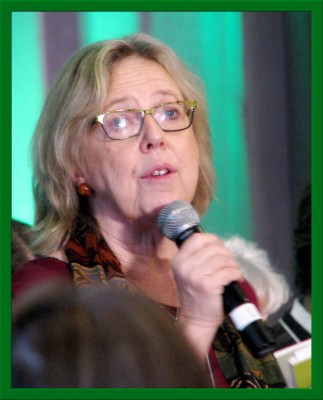
Elizabeth May at the Calgary SGM
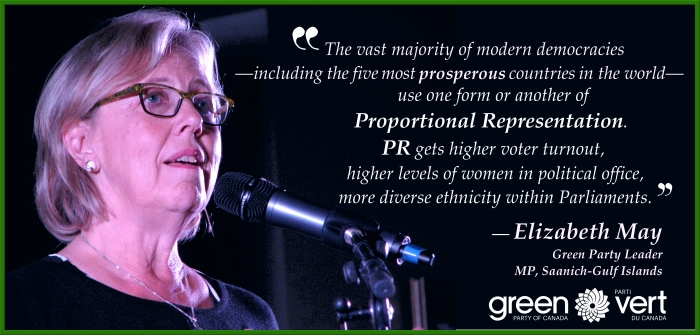
“International Day for Human Rights is a time to stop and reflect on the rights our predecessors have fought so hard for us to enjoy today. Good governance is key to promoting human rights. Unfortunately, few of us consider our right to have representatives in government who truly reflect the values that each of us cherish. Our current voting system denies a majority of Canadians representation because of our antiquated winner-take-call voting system,” said Elizabeth May, Leader of the Green Party of Canada (MP, Saanich-Gulf Islands).
“After country-wide consultations, the all-party Special Committee on Electoral Reform recommended that we get rid of First Past the Post and move to a system of proportional representation. In a country as diverse as Canada, our growth as a democracy depends on all communities being integrated into our national fabric. Ignoring the cries of our indigenous peoples has blotched our international reputation and led to wounds that will take generations to heal. The hyper-partisan attacks and lack of dialogue, created by a Parliament which vetoes rather than encourages collaboration among Parties, has resulted in growing political apathy,” Ms. May said.
Joe Foster, GPC Human Rights Critic, said: “If our democracy is to flourish in the 21st Century, Canada’s electoral system must be more accountable to the citizens it represents. Politics is the tool we use to design a social and economic framework that allows us to have the freedoms expressed in the Canadian Human Rights Charter and its sister, the Quebec Charter of Human Rights and Freedoms. Electoral reform is an issue of human rights.”
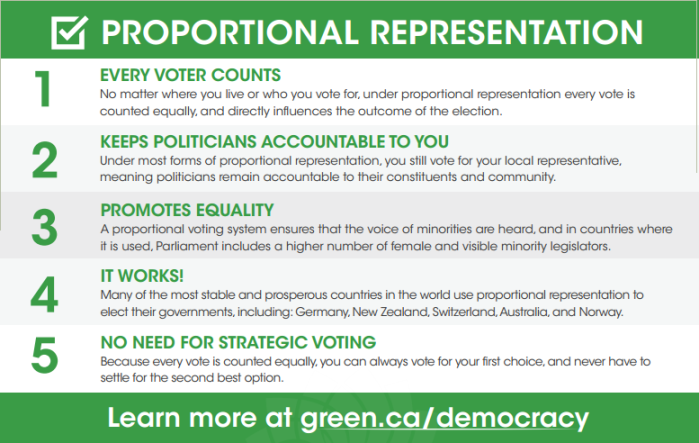
In order for this to happen, we need to be sure that the Special Committee on Electoral Reform hears us, and that the Government knows Canadians really want this change. And not just the government: MPs from every political party need to hear us. This is why the Green Party has an excellent array of tools you can use to help encourage the adoption of Proportional Representation!
One of reasons New Zealand was able to replace its First Past The Post system with Mixed Member Proportional Representation was that their main stream media properly informed voters. That is not happening here. Instead, one of our biggest obstacles is that our mainstream media doesn’t really want this change because it benefits from the status quo. This is why it is so important that we understand the issue so we can help others understand it.
And because we don’t have fair representation in Parliament, we will need to be as loud as we can, both online and off.
The GPC Toolbox includes examples of the kind of letter you might send to your local newspaper. If you’re looking for additional examples, our Fair Vote Waterloo Chapter (co-chaired by our own Bob Jonkman) has been keeping track of all the letters they have had published and posted them online.
There are also tips for using social media effectively, and graphics you can use. Since I’ve been learning and writing about the importance of Proportional Representation I’ve been creating graphics you can use as well.
There are plenty of things we can do to pitch in, check them out at the GPC Toolbox
The Green Party has long supported meaningful electoral reform to Proportional Representation, and I’ll do my best to explain why here.
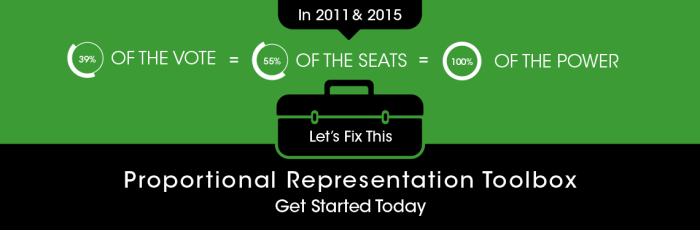
Any Proportional system Canada might adopt will be a huge improvement to our democratic process. This is because it will produce a Parliament that truly represents Canadians. As our Fair Vote friends are fond of saying, 39% of the votes will achieve 39% of the power.
Around the world, nobody switches to a First Past The Post system because it is not only antiquated, it doesn’t work very well. In fact, more than 85% of OECD countries use Proportional Representation, and some progressive countries have been using PR for well over a century.
But it is really hard to replace a First Past The Post electoral system, because the politicians who benefit disproportionately are generally not inclined to adopt a fairer system, because it will limit their own power to what they earn in votes. It is a credit to Mr. Trudeau’s government that they are going through the promised reform even after winning a majority government.
disproportional representation
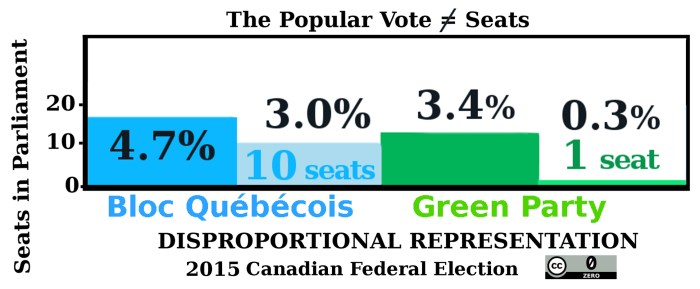
Canada’s current electoral system results in disproportional representation. This is breathtakingly apparent when you look at the back to back “majority” governments we’ve had. The thing that hits the eye with these two election result graphs is the almost identical consecutive wins achieved by different parties. The 2011 Conservatives won a phony majority with 39% of the vote, just as the 2015 Liberals won a phony majority with 39% of the vote. This is a winner take all system, so that’s the only part of the graph that matters. But looking at the details, you can see a clear picture of the unfairness in the system.
In 2011 the Bloc Québécois won 4 seats with 6% of the vote. In 2015 the Bloc Québécois won 10 seats with only 4.7% of the vote.
I don’t know about you, but I just can’t get my mind around the idea that fewer votes can more than double a party’s seats in Parliament.
In these two elections, the Green Party outcome was consistent, winning 1 seat with approximately 3 percent of the vote.
While the Green Party’s 3-4% of the vote only won a single seat in Parliament, the Bloc’s 6% and 4.76% won four and ten seats respectively. Such crazy math in the “easy to understand” First Past The Post is one of the reasons Canadians are likely to say “I don’t understand politics.”
There is a reason for the disparity between the two small parties. While both parties suffer from the inequity in our Winner-Take-All system, the Green Party’s support is spread out across Canada but Bloc voters are concentrated in the same geographic region. With more Bloc voters in a riding, the party has a much better chance to win seats. Even so, the Bloc still gets less than half as many seats as their votes warrant.
With our single member plurality electoral system, the party that wins a majority of seats wins a disproportional amount of power. This gives the candidate (and party) with the most votes the win.
Not just any win, THE win.
For a candidate, that means s/he is the only representative — and the only voice — for the electoral district where s/he was elected. For a political party, that means a majority of seats, even though that party failed to win a majority of the votes cast. And whenever anyone talks about electoral reform, that’s pretty much what everyone looks at: how our system works for political parties.
Too often forgotten in discussions of electoral reform is how our system works — or doesn’t — for the Canadian people.
Politics isn’t a job creation program for politicians, it is supposed to provide citizens with representation in Parliament so our laws and policy reflects what citizens want and need.
Our representatives are elected in single member electoral districts: that means each district elects only a single Member of Parliament who is expected to represent everyone in the electoral district. That’s what Canadians are used to, and I (like most of us, I suspect) have long thought this is how it has to be because this is how it’s always been. And yet lately I’ve been learning Canada has used a variety of different voting methods in different parts of Canada over the years.
Although our MP can help us all equally if we bring them an administrative problem that requires cutting through bureaucratic red tape, or sometimes find a compromise on a contentious issue that will satisfy most citizens, when it comes to policy, none of us can realistically expect an MP who campaigns in favour of one issue to fight against it after they have been elected.
As you can imagine, it isn’t often we’ll hear any sitting MP talking about this problem in public; so it was pretty impressive to hear former Guelph MP, Frank Valeriote admit this publicly during his last term of office.
What ordinary people expect from democracy — what we are told to expect — is that our MP will represent us. But the reality is that one person can’t possibly represent the opposing views of a hundred thousand constituents.
This is why multi-member districts — larger electoral districts which elect multiple MPs — are a great idea. When more than one MP is elected in a district, more than one view from the district can be represented in Parliament. And after all, isn’t that the point of democracy?
Electoral Reform for Greens
How many votes does it take to get a seat in Parliament?
Small parties almost always favour Proportional Representation because small parties and independent candidates are the most disadvantaged by winner-take-all systems. The graph shows us just how badly the Green Party of Canada fared in 2015. We all know that it was even worse in 2008 when almost a million votes failed to elect any Green candidates at all. From the outside it looks as though the Green Party is doing badly… worse, in fact, than 2008. Although I haven’t done a scientific study, or even conducted a public opinion poll, I don’t believe that for a minute.
Green supporters don’t often stop thinking green thoughts or wanting a sustainable future or believing green policy. But in the face of an electoral system that makes it nearly impossible to get candidates elected, intelligent people very often switch to other parties in desperation. Although we are all very much aware of the bigger parties appropriating Green policies, we don’t often realize this is often because Green supporters bring them along.
This is not just a Canadian problem; this is a feature of the First Past the Post electoral system. If we look across the pond we can see the UK has the same problems with FPTP as we do. In some ways even worse, as it took four million votes to elect a single UKIP MP in their most recent election.
Politics is not simply a numbers game. Even though most Canadians haven’t really understood why our political system fails to work the way we think it should (by providing us with representation), most of us have known the system is badly broken for a very long time. And since the system has not been working for us, so many Canadians have fallen under the spell of strategic voting in vain hopes of gaming the system to make it work for us.
I can’t tell you how many times during the campaign that people told Bob how much they wanted to vote for him but felt they couldn’t. One of the very worst things about all this strategic voting is that because so many Canadians are not voting for who/what they want, the reality is there is no way to tell what most Canadians actually do want. It’s kind of like not having accurate census data: in the absence of fact, the government is free to do whatever it likes. Especially when a single party holds a majority. It is worse still when it’s a phony majority, as most of ours are. Since 1945 there have only been 2 majority governments a majority of Canadians voted for, and before that, only 4 Canadian “majority” governments in Canada were actually elected by more than 50% of the vote. And defenders of the status quo try to paint coalition government as undemocratic!
Proportional Representation for Canada will mean larger electoral districts which have more than a single MP, and they will almost always result in coalition governments. Far from being undemocratic, majority coalition governments are elected by an actual majority of voters!
Some people think the political parties advocating for electoral reform to Proportional Representation are doing it because it will give them an advantage. This is simply not true. Proportional Representation would most certainly improve the lot of the smaller parties, but not by giving them an unfair advantage, but by removing the unfair advantage the winning party gets under our winner-take-all system. Proportional Representation is intended to ensure the votes each candidate and/or party earns is reflected in the power they get in Parliament.
Institutional Discrimination
Small parties suffer systemic discrimination in the Canadian system. Even with sitting MPs, the Green Party of Canada and the Bloc Québécois parties are not treated equally. The argument in support of this discrimination is that neither party has enough seats in the House of Commons to be counted as an official party.
But political parties are required to jump through bureaucratic government hoops to get registered by the government before any candidate is allowed to compete in an election under the party banner. Federal Registration is how a political party gets on the ballot and becomes a real party. Why isn’t a “Registered Party” an “Official Party”?
Where did this crazy idea that a party with a sitting MP is not a real party until X number of candidates have been elected come from? If there was ever any doubt about the fact “X” is a purely arbitrary construct designed to privilege the two largest parties, it was dispelled in the aftermath of the 1993 Canadian election when the Progressive Conservative Party was reduced to two seats. At that point an exception was made to allow the Progressive Conservative Party to retain the special perks of “official party” status even though it had only 2 seats. In spite of the fact the Canadian electorate had unambiguously indicated that party should no longer be so entitled.
So while the Progressive Conservative Party whose governance angered an overwhelming number of Canadians was allowed to retain its privilege, a Green Party with 2 sitting MPs was not an “Official Party,” any more than the Bloc Québécois is today with 10 sitting MPs.
But Official Party status delivers financial perks. It isn’t enough that our Winner-Take-All system gives the winning party an unfair advantage in seats, the “official parties” get extra funding for party leaders, party whips, cabinet positions, parliamentary secretaries etc. All paid for by taxpayers, including Green taxpayers — while our party is denied the funds intended to aid a party in representing its constituents. Elizabeth May is not only an Independent candidate doing a phenomenal job for her constituents in , she represents the interests of more than 600,000 voters — including those of us waaaaaay over here in Waterloo Region.
If the number of votes needed to elect a Member of Parliament was consistent, if 38,000 votes translated into one MP, as it did on average for the Liberals, the Green Party would have earned enough votes to elect 16 MPs in 2015. Which ought to be more than enough to achieve official party status even in our Winner-Take-All world. But the system we have in place is not about fairness for Canadians, it’s about keeping the real power in the hands of the two most powerful parties.
The idea that any candidate who wins an election and goes to Ottawa to sit as a Member of Parliament should be denied the same rights and respect as any other MP is not only ludicrous, it is undemocratic.
The problem is not so much that the candidate or the party is discriminated against, although that certainly isn’t fair. The real trouble is that the citizens who elected these MPs are discriminated against. Our winner-take-all system has allowed the deck to be stacked against small parties and independent candidates, but worst of all, against citizens. Seems to me all Canadian voters ought to be entitled to representation. Even in our terribly unrepresentative representative democracy, all votes should be effective because all voters should be equal.
Proportional Representation will benefit the Green Party
If the votes cast in past elections are anything to go by, Green voters are likely to benefit most from Proportional Representation. Some might suggest this is unfair, but the opposite is true. The disproportional election results we get now give the winning party an advantage it hasn’t earned at the expense of the other parties. As the Green Party is the most disadvantaged by our disproportional Winner-Take-All system, getting the seats in Parliament it deserves might look like a windfall, but the truth is the Green Party will only get the seats it has earned in votes, making it better able to represent its constituents in Parliament..
The way Green voters benefit is by actually getting the representation in Parliament we voted for.
For more information, my Whoa!Canada series is intended to demystify Proportional Representation. This is the series so far:
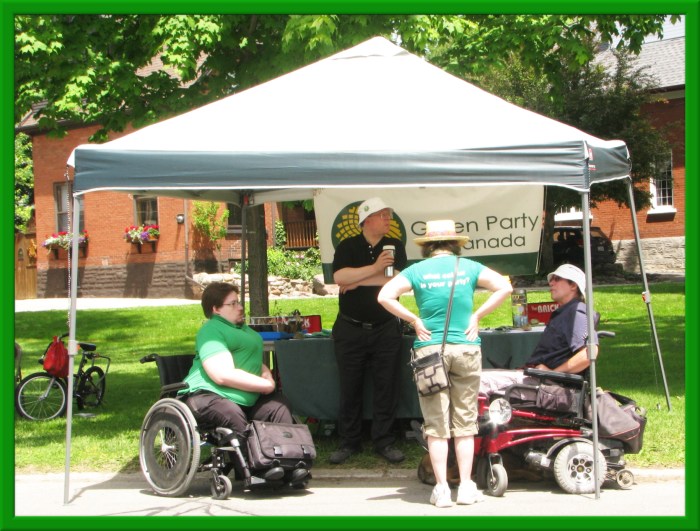
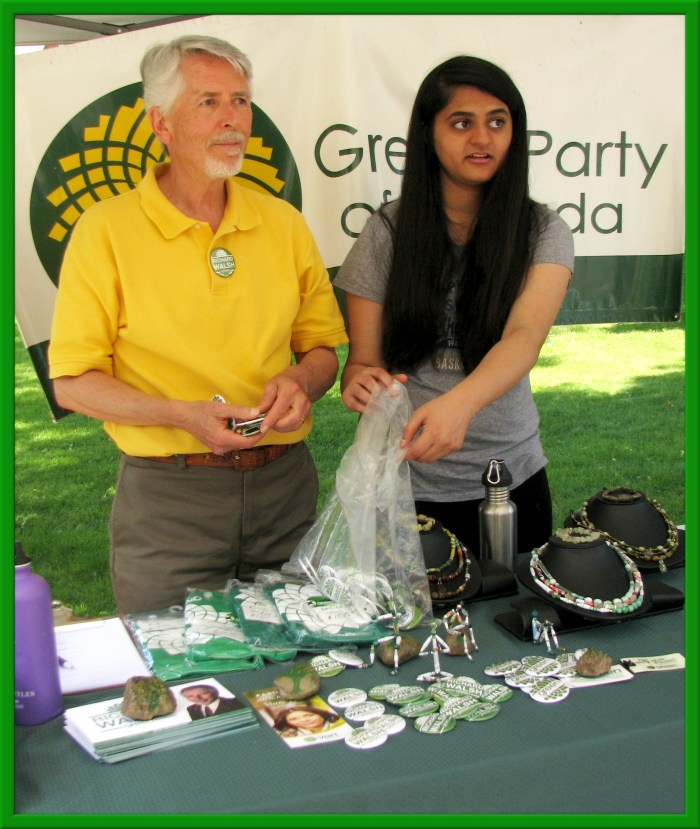
Candidates Nick Wendler (#KitCen) and Bob Jonkman (#KitCon) the K~W Multicultural Festival WRGreens Info Booth (2015)Candidate Richard Walsh (#Waterloo) dispenses Green Party buttons at the 2015 K~W Multicultural FestivalLaurel & Laura “We Can Do It”Bob Jonkman (Kitchener-Conestoga)WRGreens were selling Heritage Tomato seedlings last year.WRGreens are always happy to talk about Green issues.2015 #GPC Candidates Bob Jonkman and Richard Walsh





 But looking at the details, you can see a clear picture of the unfairness in the system.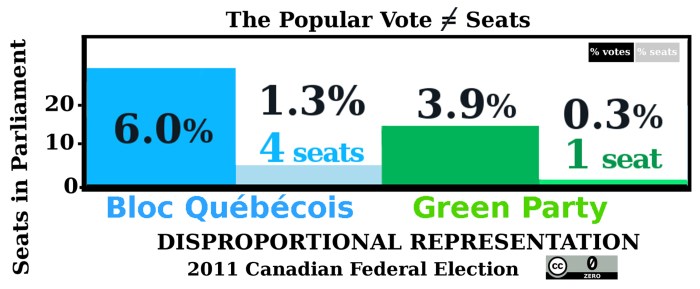















 wrgreens