Canadian and Ontario politics are badly in need of some new voices; it has become painfully clear that if we really want real change, we need to stop voting for the candidate we think might win and start voting for the candidate who will best represent us. After all, if we don’t start voting for what we want, we’ll never get it!
WRGreens need your help! Volunteers can make all the difference, and of course your vote will always be appreciated. You’ll find contact information for your WRGreens Riding in the menu link above, and if you’re not sure which is your riding, you can find out how from the “find your riding” link in the sidebar.
Although we don’t normally solicit donations here, with an election coming, this is a great time to donate if you’re going to, especially if you want the most bang for your buck. If you get your donation in by December 31st, your donation limit resets to zero so your limit resets to 0 for 2018.
In spite of the mainstream claims the 2008 recession is over, we are aware that although it may be true for the one percent, it isn’t for most people. If you aren’t in a position to donate; please don’t. Come out to our events or volunteer instead!
If you can afford to donate now (or in the future), something I did not realize before joining the party is that political donations come with tax breaks. I was shocked to learn three quarters of anything you donate up to $400 will be refunded when you do your taxes! After that the rebates reduce in size, check the chart below for details.
WRGreens aren’t set up to take online donations (yet) but you can donate directly to the Green Party of Ontario, your year-end donation of $5, $10, $25 or whatever you can afford will be most appreciated. Any donation you can make will help fund the preparations for our upcoming crucial election, mere months away!
We need Green voices at the table, not just for today, but into the future. The Green Party is a grassroots party operating on a minimal budget; with your help we can run more robust campaigns, and elect more Greens!
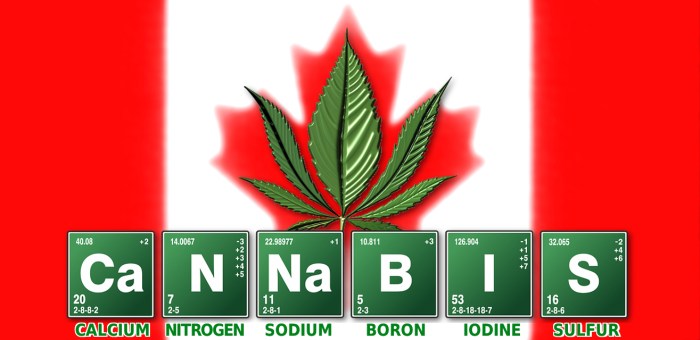
The federal Green Party platform promised legalization instead of decriminalization.
“Ending the war on drugs
“Between 2008 and 2011, according to the Department of Justice, Canada spent $311 million targeting illicit drugs, with a majority of that money going to law enforcement. Most of that was for the ‘war’ against cannabis (marijuana). Marijuana prohibition is also prohibitively costly in other ways, including criminalizing youth and fostering organized crime. Cannabis prohibition, which has gone on for decades, has utterly failed and has not led to reduced drug use in Canada.
“After analyzing the recommendation of the Canadian Senate’s 2002 Special Committee on Drugs and the examples of strategies used by some European countries, the Green Party of Canada has come to the conclusion that it is time to legalize the adult use of marijuana. Furthermore, the Greens believe that drug addictions should be treated as a health problem, not as criminal offences.
“Green Party MPs will:
Legalize marijuana by removing marijuana from the drug schedule;
Create a regulatory framework for the safe production of marijuana by small, independent growers;
Develop a taxation rate for marijuana similar to that of tobacco;
Establish the sale of marijuana to adults for medicinal or personal use through licensed distribution outlets;
Educate the public about the health threats of marijuana, tobacco, and other drug use;
Launch a public consultation on the decriminalization of illicit drugs, considering the current high costs of the law enforcement effort;
Provide increased funding to safe injection sites, treatment facilities, and addict rehabilitation.
Like the Green party, Justin Trudeau’s Liberal Party.promised Legalization, although not in quite the same way :
“We will legalize, regulate, and restrict access to marijuana.
“Canada’s current system of marijuana prohibition does not work. It does not prevent young people from using marijuana and too many Canadians end up with criminal records for possessing small amounts of the drug.
“Arresting and prosecuting these offenses is expensive for our criminal justice system. It traps too many Canadians in the criminal justice system for minor, non-violent offenses. At the same time, the proceeds from the illegal drug trade support organized crime and greater threats to public safety, like human trafficking and hard drugs.
“To ensure that we keep marijuana out of the hands of children, and the profits out of the hands of criminals, we will legalize, regulate, and restrict access to marijuana.
“We will remove marijuana consumption and incidental possession from the Criminal Code, and create new, stronger laws to punish more severely those who provide it to minors, those who operate a motor vehicle while under its influence, and those who sell it outside of the new regulatory framework.
“We will create a federal/provincial/territorial task force, and with input from experts in public health, substance abuse, and law enforcement, will design a new system of strict marijuana sales and distribution, with appropriate federal and provincial excise taxes applied.”
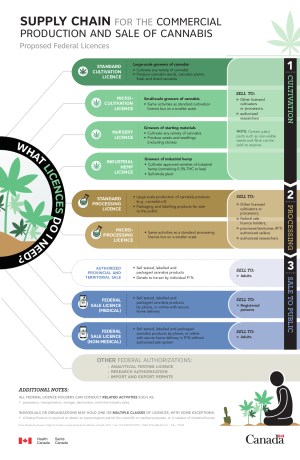
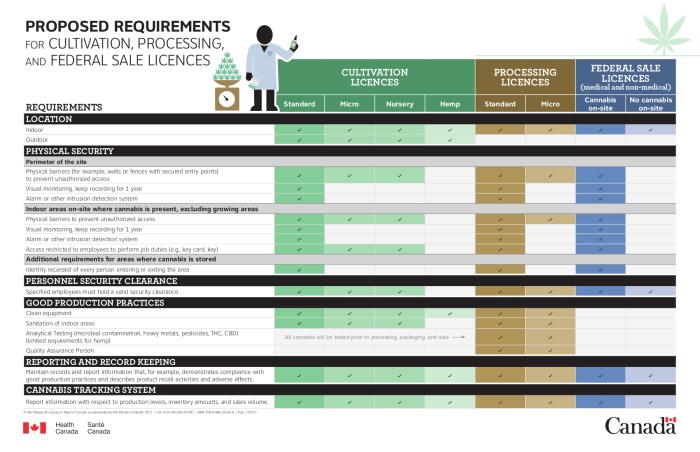
On November 21st, 2017 the Health Canada branch of the Justin Trudeau Government began a public consultation that will be open until January 19th, 2018. One might think the Government would undertake its public consultation before actually drafting legislation. A cynical citizen might suspect such a backward agenda might indicate the consultation was purely for show. An optimistic Canadian might think better late than never.
“The Liberal’s big government ‘lets benefit political insiders’ approach to things just doesn’t make sense.”
— Mike Schreiner, Leader, Green Party of Ontario
To legalize marijuana sales in Ontario, the GPO supports:
✅ Regulating and licensing small businesses and dispensaries to sell marijuana in a safe and controlled way
✅ Ensuring tax revenues from marijuana sales are used to fund education, mental health and addiction programs
✅ Creating more local jobs and boosting prosperity by supporting small businesses
But the Green Party is not in charge.
Canadian Cannabis Crackdown
Because cannabis was illegal before any sort of scientific testing was done, there has been precious little modern scientific study of the substance. What little study there has been suggests negative effects of cannabis are less harmful than many other substances that can be purchased openly and legally by anyone. Like aspirin. People can kill themselves with aspirin. But it is physically impossible for anyone to kill themselves with cannabis.
The worst health risks with cannabis centre around the fact that it is most often smoked in combination with tobacco, and we now know tobacco is hazardous to our health. And yet the Canadian Government only allowed patients access to edibles after another Supreme Court challenge.
“We believe, however, that the continued prohibition of cannabis jeopardizes the health and well-being of Canadians much more than does the substance itself or the regulated marketing of the substance. In addition, we believe that the continued criminalization of cannabis undermines the fundamental values set out in the Canadian Charter of Rights and Freedoms and confirmed in the history of a country based on diversity and tolerance.”
— Senate Special Committee on Illegal Drugs (2002) REPORT OF THE SENATE SPECIAL COMMITTEE ON ILLEGAL DRUGS
And yet the Canadian Government promising cannabis legalization has increased it’s war on cannabis even more. They are cracking down on cannabis at a frantic pace in the lead up to legalization.
This is not right.
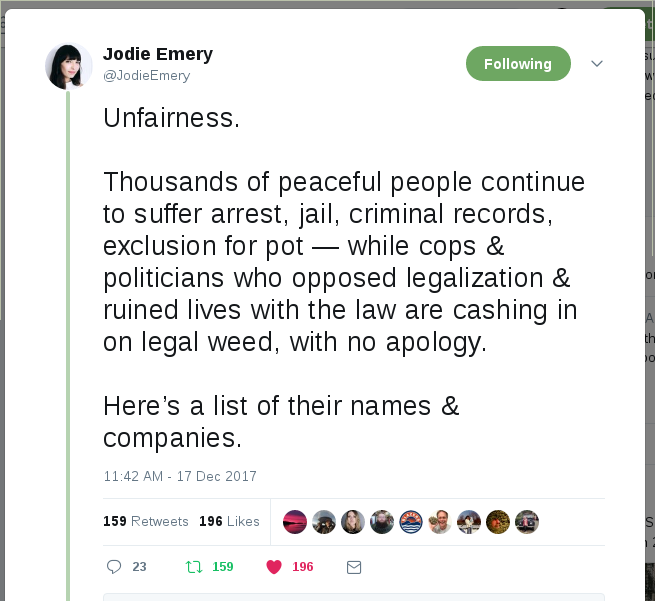
Who profits?
“I see legalizing [marijuana] or putting it in shops as trying to normalize narcotics, when the truth is there is nothing normal about it. It’s a mind-altering drug that causes impairments and like cigarettes is not healthy.”
Fantino says he understands the enticement of marijuana. It’s a new cash frontier where many people, including many former police officers and politicians, could get in on the ground floor. This helps explain why the marijuana lobby is so opposed to Prime Minister Stephen Harper.
Trudeau might be their best chance to move this fight forward. With Harper, it’s dead.
“There’s a lot of money in it,” Fantino said. “Big money.”
He said he was offered “to fall in with a company” that wanted to pay him very well to simply lend his name to it.
Kash Heed, strategic consultant with National Green BioMed
— Former B.C. Solicitor General and former West Vancouver police chief Medical marijuana business no gold rush
Jake Ryan, Director of Security for Tilray
— Former RCMP Intelligence Officer and federal criminal investigator overseeing all aspects of Tilray’s security protocols and operations Why Medical Marijuana Could Be the Modern Gold Rush
Senator Larry Campbell, advisor to Vodis Innovative Pharmaceuticals Inc.
— Former Royal Canadian Mounted Police officer and Vancouver mayor, sitting Senator, and
Julian Fantino, co-owner Aleafia Total Health Network
— Former Toronto Police Chief, former Chief of York Region, former Chief of London, Ontario Provincial Police commissioner, and
Jerry Habuda, board of PUF Ventures
— Former Toronto Police officer, spent a large part of his career investigating drug crimes, including undercover work, surveillance, patrol at a community housing project, investigating those on bail for drug crimes PUF:Canadian Sec Stock Quote – PUF Ventures Inc
Joe Perino, board of PUF Ventures
— Former Toronto Police officer, 30-year veteran of the service who worked on the force’s drug investigations unit
Cole Cacciavillani, cofounder and co-chair of Aphria, one of the country’s largest marijuana companies
— Former member of the police services board in his community Aphria Founder: Cole Cacciavillani
POLITICIANS and PUBLIC SERVANTS
Chuck Rifici, founder and former CEO of Tweed (now Canopy Growth) and now Cannabis Wheaton
— Former Chief Financial Officer of the Liberal Party of Canada under Justin Trudeau These prominent Canadians want you to buy their weed
Mark Zekulin, CEO of Tweed
— Former senior adviser to former Ontario finance minister Dwight Duncan, and
Dr. Joshua Tepper, Independent Director at Mettrum
— Formerly Assistant Deputy Minister at the Ministry of Health, Senior Medical Officer for Health Canada, and
Anne McLellan, Bennett Jones Law
— Former Deputy Prime Minister of Canada, Minister of Public Safety and Emergency Preparedness, Minister of Health, Minister of Justice and Attorney General of Canada, head of the Liberal Legalization Task Force Questions raised over marijuana task force chair’s ties to industry
Ivan Vrana, founder of Aslan Ross Consulting
— Worked for the Federal Government; the Patented Medicine Prices Review Board, Finance Canada and in various senior policy positions at Health Canada; involved in Marihuana for Medical Purposes Regulations Canadian Medical Marijuana MMPR Consultant Ivan Ross Vrána Interview
Sandy Pratt, Chief Financial Officer, Emerald Health
— Worked at Deloitte (auditing firm involved in the senate scandal), Vice President of Business Development and Executive Financial Officer of the Royal British Columbia Museum, a Crown corporation About Emerald Health Botanicals
Shane Morris, VP, Scientific Affairs and Stakeholder Relations for Hydropothecary CEO
— Federal Government, Treasury Board of Canada’s senior advisor on regulatory affairs; reporting for Resources Canada’s major projects management office Former B.C. health minister Terry Lake to join growing marijuana company
George Smitherman, THC BioMed, Alta Vista Ventures
— Former Ontario Liberal deputy premier; 30+ years public policy fields at Municipal, Provincial, Federal Level; Senior Advisor, Minister of Energy and Infrastructure and Ontario’s Minister of Health How public officials got into the weed game
Ernie Eves, Chairman, Timeless Herbal Care (a Jamaican medical marijuana company)
— Former Progressive Conservative premier of Ontario, and
Terry Lake, Vice President of Hydropothecary Corp.
— Former health minister of British Columbia, and
Max Cyr, director of customer experience Hydropothecary
— Former supervisor of a medical marijuana police and client services division within Health Canada
I urge every Canadian to participate in the government’s consultation, even those— especially those— like me, who have no personal connection with cannabis.
Regards,
Laurel Russwurm
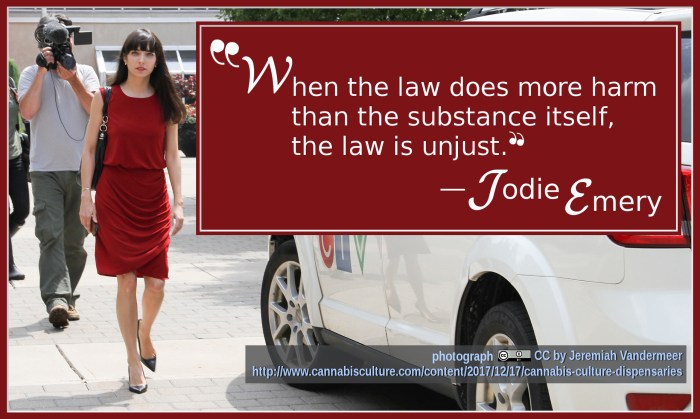
p.s. Jodie and Marc Emery are facing a massive fine as a direct result of their cannabis activism. If you wish to support their work, you can do so at the Marc and Jodie Emery Support gofundme Page
December 6th, 1917 was the day thousands of people died, and thousands more were injured in Halifax, Nova Scotia. The Halifax Explosionwas the largest explosion the world had ever seen before the nuclear age. Today is the hundredth anniversary of that horrific event. But bad as it was, it was an accident.
The same can not be said for the tragic event of December 6th, 1989.
A disturbed young man deliberately murdered Geneviève Bergeron, Hélène Colgan, Nathalie Croteau, Barbara Daigneault, Anne-Marie Edward, Maud Haviernick, Maryse Laganière, Maryse Leclair, Anne-Marie Lemay, Sonia Pelletier, Michèle Richard, Annie St-Arneault, Annie Turcotte, Barbara Klucznik-Widajewicz at the École Polytechnique.
Because they were women.
I chose to use the roses because they were part of a candlelight vigil in on December 6th, 2016 in Chilliwack, BC. People across Canada continue to share in this sorrow.
Decades later, Canadians continue to mourn, but the sad fact is that violence against women in Canada shows no sign of abating. Perhaps we need more than a day.
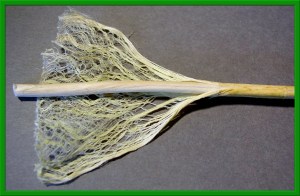
French pioneer apothecary Louis Hébertwas the first European farmer in Canada. Cannabis Sativa, a plant known as “hemp,” was one of his crops.
The sails of sailing ships, canvas, rope, and linen were all manufactured from the rugged fibres of the hemp plant. As was the earliest known paper. Hemp dominated the paper trade until it was replaced by wood fibre in the 1800s.
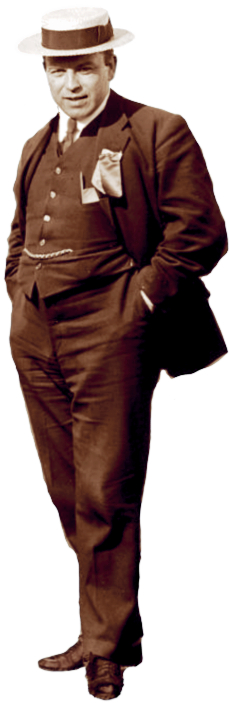
There were no illegal drugs in Canada prior to the 20th Century. Deputy Minister of Labour William Lyon MacKenzie King changed all that in 1908.
“On Sept. 7, 1907, the Asiatic Exclusion League of Vancouver went on a rampage though the city’s Chinatown and Little Tokyo. No one was killed, but there was considerable property damage.
“The Liberal government of Wilfrid Laurier sent William Lyon Mackenzie King, the country’s first deputy minister of labour, to investigate.”Among the many individuals who submitted claims for restitution were several Chinese opium dealers, which prompted King to study the opium trade in Vancouver.
“There were no laws then governing the use of opium or other drugs; and, in fact, during the 19th century, laudanum, a mixture of liquid opium and alcohol and highly addictive, was popular as a pain remedy.
“King was stunned by what he learned about the corrupting influence of opium, connected as it was with widespread notions that Chinese men used opium to exploit and sexually assault white women.”
A year later the Canadian Government instituted the first legislation to regulate the use of medicine to protect the public in The Proprietary or Patent Medicine Act (1909). As an ingredient used in many such medicines, cannabis was regulated by this act.
The illicit opium smuggling that sprang up in answer to the Opium Act warranted a Royal Commission. Its recommendations to:
make sale, possession & smoking illegal drugs separate offenses, and
“While the Chinese were being blamed for bringing opium to Canada’s doorstep, it was the mighty British colonial empire that was harvesting, refining and selling the drug on a massive scale.
“The British controlled vast poppy fields in South Asia — and soon discovered that making opium in India and shipping it to China made for very profitable business.
“As the drug began to flood into China, wreaking havoc on the economy and society, Chinese authorities attempted to shut it down by boarding British ships and destroying opium shipments.
“The British army responded by arresting those responsible and seizing harbours, ports, and cities along China’s coast and up the Pearl River.”
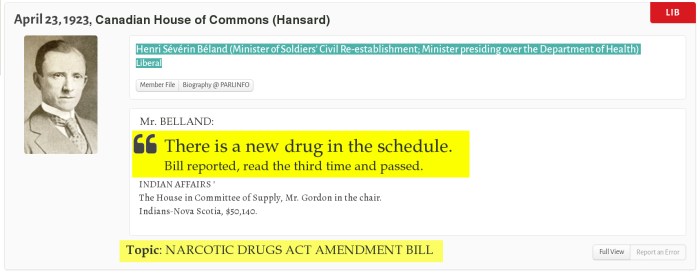
When William Lyon Mackenzie King became Prime Minister, the scope of his legal war on drugs continued to expand with the Narcotic Drugs Act Amendment Bill in 1923. Part of the reason for this law was to combine the growing body of law dealing with illegal drugs into one.
There was no discussion, just that one sentence spoken in Parliament added Cannabis to the Schedule of Controlled Substances without even naming it aloud in Parliament. (It was passed by the Senate without a word as well.)
There had been no mention of cannabis in the draft legislation (although it had been appended to one of the copies) but more importantly, it wasn’t a social issue when they made it illegal. Most Canadians hadn’t even heard of the stuff (under any name).
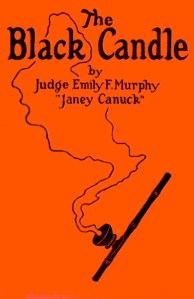
Those who had, knew of it as “marahuana,” thanks to the sensational writings of Judge Emily Murphy (of Famous Five fame). Her series of articles about illegal drug use for Macleans Magazine published under the pseudonym “Janie Canuck” formed the basis of her book “The Black Candle.” Taken as a whole, the racist dogwhistle Ms Murphy’s book was blowing warned of an international drug conspiracy to bring about the “downfall of the white race.” Several of the photographs depict addicted white women consorting with men of colour to help drive home Ms Murphy’s race war narrative.
“One becomes especially disquieted — almost terrified — in face of these things, for it sometimes seems as if the white race lacks both the physical and moral stamina to protect itself, and that maybe the black and yellow races may yet obtain the ascendancy.”
The incendiary book plied the reader with misinformation about of the dangers of “marahuana.” Although hemp was grown in Canada, there was no actual evidence supporting Ms Murphy’s imaginings, although she had no shortage of specious “expert” testimony to present.
Charles A. Jones, the Chief of Police for the city, said in a recent letter that hashish, or Indian hemp, grows wild in Mexico but to raise this shrub in California constitutes a violation of the State Narcotic law. He says, “Persons’ using this narcotic, smoke the dried leaves of the plant, which has the effect of driving them completely insane. The addict loses all sense of moral responsibility. Addicts to this drug, while under its influence, are immune to pain, and could be severely injured Without having any realization of their condition. While in this condition they become raving maniacs and are liable to kill or indulge in any form of violence to other persons, using the most savage methods of cruelty without, as said before, any sense of moral responsibility.
“When coming from under the influence of this narcotic, these victims present the most horrible condition imaginable. They are dispossessed of their natural and normal will power, and their mentality is that of idiots. If this drug is indulged in to any great extent, it ends in the untimely death of its addict.”
Ms Murphy’s best seller is thought by some to have influenced the decision to quietly add Cannabis to the schedule a year later.
At the time they made it illegal, Cannabis was such a non-issue that:
“The first seizure of marijuana cigarettes occurred only in 1932, nine years after the law had passed (p. 182); the first four possession offences (it is not clear whether these were charges or convictions) occurred in 1937, 14 years after cannabis was criminalized (p. 599)
No one really knows the “why” of it. Racism was clearly a factor in Canada’s war on drugs, but the reality was that Marijuana didn’t become a social issue until long after Cannabis had been made illegal. Although criminalization led to a handful of arrests here and there, marijuana arrests never exceeded 100 annually prior to the 1960s. Some think the real reason Cannabis was added to the schedule was to eliminate the hemp industry, but something else to consider is that its inclusion in the schedule meant it could no longer be used for medicinal purposes in Canada, so pharmaceutical competition may have been the reason.
The maximum penalty for possession of small quantities was six months in prison and a $1,000 fine for a first offence.[26] Convictions for cannabis skyrocketed, from 25 convictions between 1930 and 1946, to 20 cases in 1962, to 2,300 cases in 1968, to 12,000 in 1972.[27] The Narcotics Control Act of 1961 increased maximum penalties to 14 years to life imprisonment.[28]
Even though Cannabis still hadn’t become a big problem, its continued presence on the Schedule was supported by the Minister of National Health’s (now debunked) argument that it was a gateway drug,
The use of marijuana as a drug of addiction in Canada is fortunately not widespread. It, however, may well provide a stepping stone to addiction to heroin and here again cultivation of marijuana is prohibited except under licence.
But by the mid-1960’s the recreational drug culture had become a social problem among Canadian youth. Prime Minister Pierre Trudeau’s government tasked Gerald Le Dain to look into it. LeDain’s Royal Commission of Inquiry Into The Non-Medical Use of Drugs invested four years in an exhaustive study of the issue, even going so far as to interview John Lennon in December 1969.
Lennon’s testimony suggested flagrant government misinformation about the effects of marijuana led users to assume legitimate government warnings about the hazards of hard drugs were also unfounded propaganda. And indeed, the Le Dain Commission concluded that there was no scientific evidence warranting the criminalization of cannabis.
“Marie-Andree Bertrand, writing for a minority view, recommended a policy of legal distribution of cannabis, that cannabis be removed from the Narcotic Control Act (since replaced by the Controlled Drugs and Substances Act) and that the provinces implement controls on possession and cultivation, similar to those governing the use of alcohol.[2]”
Today’s Prime Minister Justin Trudeau told a young man at a Vice Town Hall about his brother’s predicament:
“…he was charged with possession. When he got back home to Montreal my Dad said, ‘Okay, don’t worry about it.’ reached out to his friends in the legal community, got the best possible lawyer, and was very confident that we were going to be able to make those charges go away.
“We were able to do that because we had resources, my Dad had a couple connections, and we were confident that my little brother wasn’t going to be saddled with a criminal record for life.”
Our Green friends in Brantford—Brant have extended us an invitation to a multifaceted family event in support the Paris Pit Ministerial Appeal.
Snack on delicious desserts and enjoy fantastic live music with Madison Galloway and check out the live auction with Nick Maidment. You’ll also have an opportunity to meet special guest Dr. Poh-Gek Forkert, a researcher and toxicologist who’s published more than eighty papers and book chapters on the metabolism of toxic chemicals. Her most recent work was on the Paris Pit case with the Concerned Citizens of Brant (CCOB). She’ll also talk about her new book Fighting Dirty: How a Small Community Took on Big Trash, the story of one small group of farmers, small-town residents, and Indigenous people who took on the world’s largest waste disposal company to stop them from expanding a local dumpsite into a massive land fill.
“It struck me early on, though, that for all their deep roots in this land, community members didn’t have a voice in decisions about how that land was to be used. As a scientist, I was trained to be dispassionate, objective, logical, rational—and none of that changed. But for the first time in my personal life, I joined forces with a community of people as they fought to avert environmental catastrophe.”
— Dr. Poh-Gek Forkert
If you’ve already got your copy of “Fighting Dirty,” bring it along so Dr. Forkert can sign it; but if you haven’t, I expect you’ll be able to pick up a copy on Saturday.
Brantford-Brant Greens, the Grand River Environmental Network, OPAL Alliance and others have partnered with the CCOB in sharing our concern for this fragile watershed and supporting the precautionary measures that must be taken to protect our water.
Celebrate Our Waters: A Family Event, Book Launch and Fundraiser Saturday, November 18the, 2017 2-5pm St. Paul’s United Church 48 Broadway Street West, Paris, Ontario, N3L 2S5
Unsurprisingly the big one was Mr Trudeau’s badly broken Electoral Reform promise.
Democratic deficit, the failure to restore protections to “navigable waters,” Environment policy direction, Climate Change policy, failure to live up to Reconciliation, ignoring evidence given by experts and citizens to Parliamentary Committees and National Consultations… there is much need for improvement.
“…the intangibles are re-engaging Canadians in having faith and hope and trust in a government — if you squander that you encourage cynicism and you hurt democracy in a fundamental way.”
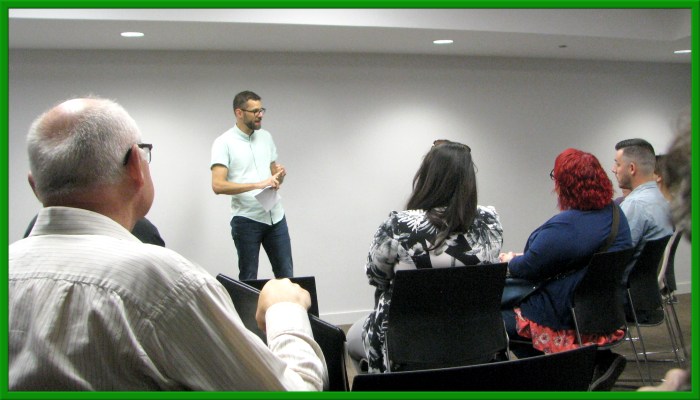
WRGreens congratulate Waterloo’s “Zee” Zdravko Gunjevic and Kitchener Centre’s Stacey Danckert on their nomination as Green Party Candidates at Sunday’s combined WRGreens GPO Constituency Association nomination meeting at the Kitchener Public Library.
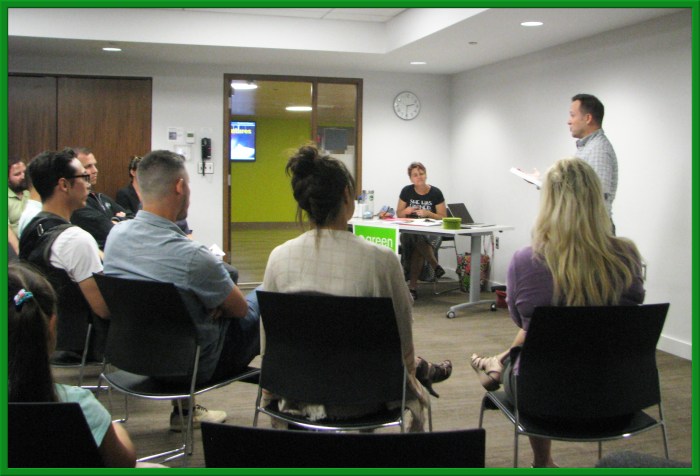
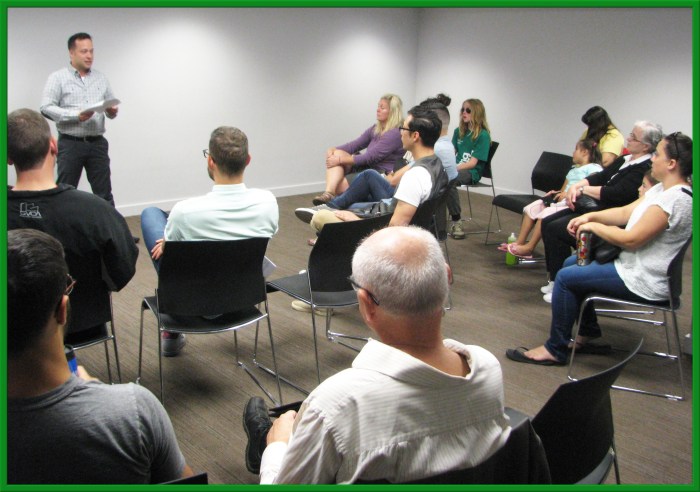
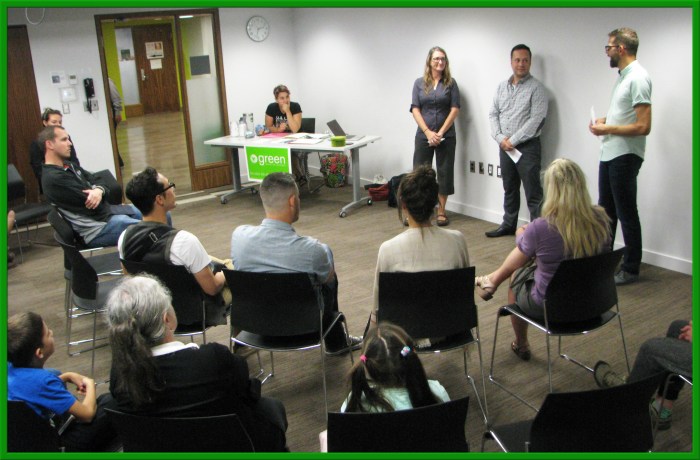
WRGreens Kris Braun introduces the Candidate NomineesStacey Danckert for Kitchener CentreThe former Waterloo Candidate talks about why she wants to represent Kitchener Centre.The last riding boundary redistribution moved Stacey to Kitchener CentreZdravko Gunjevic for Waterloo“Zee” Zdravko Gunjevic talks about why he wants to represent WaterlooThis is Zdravko Gunjevic’s first time seeking a political nominationWhile the voting members cast ballots, Bryan Izzard readies the refreshmentsBryan’s fabulous food was (as always) a hitTeresa announces the candidates!Introducing the new candidates: Stacey Danckert and Zdravko GunjevicJulia Gogoleva and Sam Nabi talk about Volunteer Organizing for WRGreensSmall Group Discussion
A second combined nomination meeting for the other WRGreens ridings is in the works, possibly for December. We’ll keep you posted!
Photos by Laurel Russwurm released under a Creative Commons Attribution License may be attributed to WRGreens. These (and many more) are available in the WRGreens Flickr album.
NOTE: If you find yourself in one of our blogs or Flickr albums but would prefer not to appear there, or should you wish to remain but be identified by name, please contact Laurel at laurel.russwurm@gpc.ca
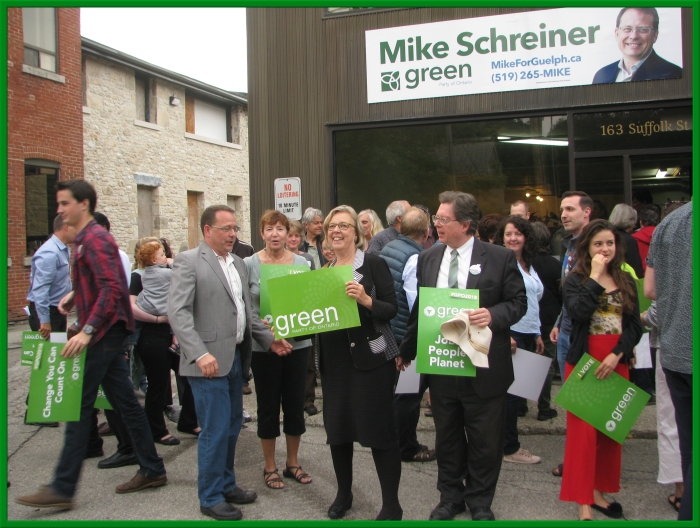
On Tuesday October 6th, 2017 #KitCon Greens Laurel and Bob joined the Guelph Greens to celebrate the Grand Opening of their new Office.
Deputy Leader Bonnie North (Barrie—Innisfil) joins Mike at the opening.Kitchener Conestoga’s Bob Jonkman networks with Greens from around Ontario.Elizabeth May joined the Guelph Greens for the Grand Opening celebration.Elizabeth introduces Mike SchreinerMike says a few words (video coming)
When Greens get together there’s always plenty to talk aboutDiscussing Green IssuesMike Schreiner is great to talk toBob (Kitchener—Conestoga), Pat (Halton), Elizabeth (Saanich—Gulf Islands) Ingrid and Ken (Brantford—Brant)
Mike leads!panorama: getting ready for the group photo [link to official GPO Group Photo]Photographers at WorkGreen Leadership in Ontario Mike Schreiner (Green Party of Ontario Leader) and Elizabeth May (Green Party of Canada Leader)Next time you’re in Guelph, stop by the office at 163 Suffolk and say “hi” Those of us who navigate by landmarks can look for the Mike For Guelph banner hanging above the storefront 🙂
 Canadian and Ontario politics are badly in need of some new voices; it has become painfully clear that if we really want real change, we need to stop voting for the candidate we think might win and start voting for the candidate who will best represent us. After all, if we don’t start voting for what we want, we’ll never get it!




 “On Sept. 7, 1907, the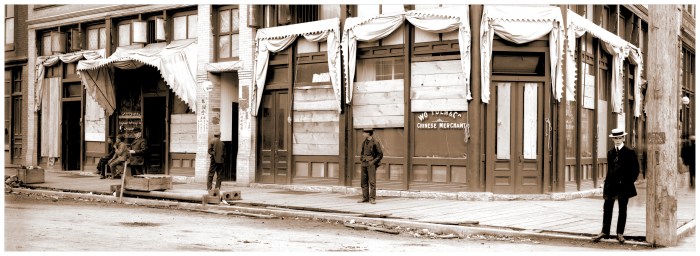




 Unsurprisingly the big one was Mr Trudeau’s badly broken Electoral Reform promise.












 wrgreens
